Search for more information
Every project eventually lands on the same shortlist: Monel, 904L, Hastelloy C-276. Three names, three price tags that can differ by a factor of four, and three metallurgical philosophies that are often confused with one another. The real risk is not overpaying — it is choosing an alloy that looks right on the data sheet and fails in year two.
The most common mistake is treating these grades as points on a single ladder: good, better, best. They are not. Monel is a nickel-copper alloy that wins where chlorides meet reducing acids. 904L is a super-austenitic stainless steel that buys serious chloride resistance at a stainless steel price. C-276 is a nickel-chromium-molybdenum alloy built for the mixed oxidizing-plus-reducing chemistries that destroy almost everything else.
Pick by price and you will usually pick wrong. Pick by chemistry — first the medium, then the temperature, then the fabrication route — and the answer tends to select itself.
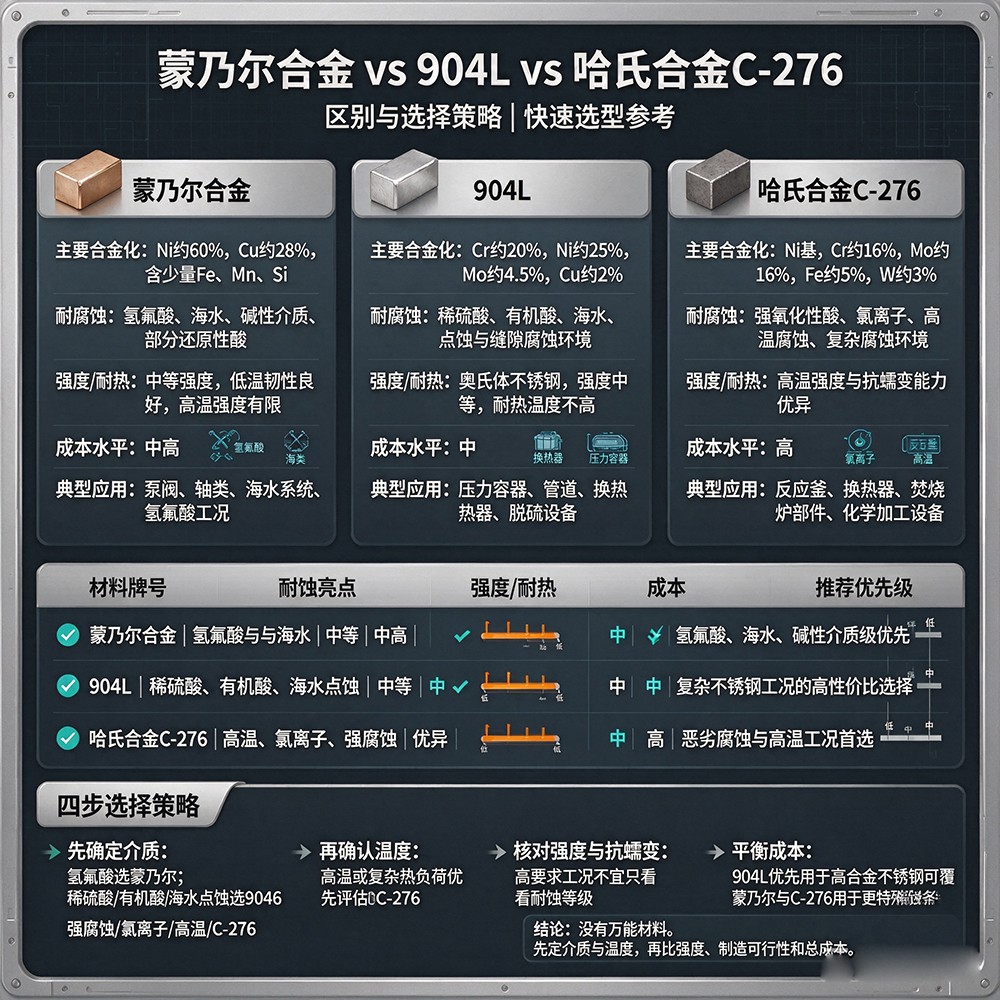
Before the detail, here is the whole argument in one table. The "relative cost" column is an index per kilogram of mill product (904L = 1), not a quotation — alloy surcharges move, and fabrication cost often matters more than the metal itself.
| Attribute | Monel 400 | 904L (N08904) | Hastelloy C-276 |
|---|---|---|---|
| Family | Nickel-copper, ~65Ni-32Cu | Super-austenitic stainless, ~25Ni-21Cr-4.5Mo-1.5Cu | Ni-Cr-Mo-W, ~57Ni-16Cr-16Mo-4W |
| PREN* | Not applicable (no Cr) | ~34–36 | ~68 |
| Strongest in | Hydrofluoric acid, flowing seawater, caustic, chloride SCC | Sulfuric and phosphoric acid, chloride pitting/SCC at moderate temperature | Mixed acids, wet chlorine, hypochlorite, HCl, flue-gas desulfurization |
| Fails in | Oxidizing acids (nitric), ferric chloride, chlorinated seawater | Hot concentrated HCl, high-temperature strength duty, stagnant seawater | Nothing cheaply — but cost, machining and availability all bite |
| Typical max metal temp. | ~480 °C (sulfur-free) | ~400 °C, and only mildly oxidizing | ~1000 °C where strength is not the driver |
| Relative cost (index) | ~1.4 | 1.0 | ~3.5 |
*PREN = Cr% + 3.3 Mo% + 0.5 W%. It is a pitting-resistance indicator, not a corrosion rate prediction. Values are typical and should be confirmed against the mill certificate and the applicable ASTM specification (B127, B674, B575).
The chloride specialist. Near-immune to chloride stress cracking, and the default answer for hydrofluoric acid.
The value play. Roughly a third of C-276's price for most of its chloride performance.
The insurance policy. Handles oxidizing and reducing in the same stream, which almost nothing else does.
Monel 400 is a single-phase nickel-copper alloy with roughly 65% nickel. That high nickel content is doing two jobs: it stabilizes the alloy against chloride stress corrosion cracking, and it gives it real resistance to reducing acids — the ones that generate hydrogen rather than consume it.
Where it earns its price: hydrofluoric acid at essentially all concentrations up to the boiling point, which is why it became the standard material for HF alkylation units; flowing seawater, particularly at high velocity, where its hardness and ductility resist impingement, erosion and cavitation far better than austenitic stainless steels; and hot caustic soda, where nickel-based grades outperform stainless by a wide margin.
It also has two properties engineers underuse. Thermal conductivity is several times that of austenitic stainless steel — useful in heat-transfer equipment — and it stays tough at cryogenic temperatures, with no ductile-to-brittle transition, which is why Monel appears in LNG and cryogenic handling. The age-hardenable version, Monel K-500, adds roughly double the yield strength for pump shafts, valve stems and fasteners.
Monel hates oxidizers. Nitric acid, ferric chloride, wet chlorine, hypochlorite and chlorinated seawater will attack it quickly and locally. A seawater system that is perfectly fine on Monel becomes a liability the day someone installs a chlorine injection point upstream. Aerated HF vapour and mercury contamination are also known cracking risks — both are easy to overlook in a process description.
904L is a fully austenitic, low-carbon stainless steel with about 25% nickel, 21% chromium, 4.5% molybdenum and 1.5% copper. Its PREN of roughly 35 sits well above 316L (~26) and 317L (~30), which translates into a meaningfully higher resistance threshold for pitting and crevice corrosion in chloride-bearing water.
The copper addition is the detail people forget. It is there for sulfuric acid: 904L handles dilute to moderately concentrated H2SO4 at ambient and moderate temperatures, and it is a standard grade for chemical tankers carrying sulfuric and phosphoric acid cargoes. It is equally at home in wet-process phosphoric acid with its chloride and fluoride impurities, in pulp and paper bleach plants, in acetic acid, in flue-gas desulfurization ductwork and in once-through seawater cooling where flow is maintained.
Its commercial role is what makes it interesting: 904L delivers a large share of C-276's chloride performance at roughly a third of the metal cost, and it welds, forms and machines like a stainless steel rather than a nickel alloy. Most of the "we specified C-276 everywhere" bills of material in the world contain a few items that would have been perfectly happy as 904L.
The limits are equally clear. It is not a heat-resistant grade — above roughly 400 °C its strength and scaling behaviour stop being design-worthy. It is poor in hydrochloric acid, marginal in wet chlorine and hypochlorite, and still vulnerable to crevice corrosion under deposits or in stagnant seawater, where the local chemistry can outrun its PREN. And like any austenitic grade, it needs the low-carbon chemistry and controlled welding practice to avoid sensitization in the heat-affected zone.
C-276 is a nickel-chromium-molybdenum alloy with about 16% molybdenum, 16% chromium and 4% tungsten, deliberately held to very low carbon and silicon so that intermetallic phases do not form in the weld heat-affected zone. That low-carbon design is what makes it weldable in the field without a post-weld solution anneal — a practical advantage that decides many real specifications.
Its defining property is range. Chromium provides oxidizing resistance; molybdenum provides reducing resistance; tungsten extends both. Very few alloys tolerate a stream that is simultaneously acidic, chloride-rich and mildly oxidizing — pickling liquors, chlorine dioxide bleach stages, scrubber liquors, sour gas with CO₂ and H₂S. C-276 does, and it also handles hydrochloric acid across the full concentration range to high temperature, wet chlorine gas, hypochlorites, and ferric and cupric chlorides, all of which destroy 904L and Monel in short order.
It is also the safe answer where chlorination is unavoidable: C-276 has excellent resistance to crevice corrosion and chloride SCC in chlorinated seawater, which is exactly the case that rules out both Monel and 904L. In flue-gas desulfurization — arguably its largest single application — it survives the limestone slurry, the chloride build-up and the oxidizing outlet chemistry in one material.
None of this is free. C-276 costs three to four times 904L per kilogram, work-hardens rapidly, and machines at low surface speeds with positive rake geometry — shops that quote it as if it were stainless steel will lose money. It is also not universal: in strongly oxidizing high-temperature service, C-22 or 625 can outperform it, and where elevated-temperature strength is the real requirement, it is the wrong family entirely.
Five questions, asked in order, will resolve most cases before anyone opens a price list.
HFMonel 400, provided there is no oxidant and no chlorination.
H₂SO₄904L for ambient-to-moderate, chloride-bearing sulfuric and phosphoric service; C-276 once it turns hot, concentrated or oxidizing.
Cl⁻ + O₂C-276 for chlorinated seawater, wet chlorine, hypochlorite, chlorine dioxide and mixed pickling acids.
Chlorinating a Monel seawater system. The single most common and most expensive error. Monel's seawater reputation assumes clean, un-chlorinated water. Add hypochlorite dosing and the corrosion rate changes by orders of magnitude.
Choosing 904L for chlorinated or stagnant seawater. Under deposits, in low-flow branches and in closed loops, crevice chemistry can defeat a PREN of 35. If the flow cannot be guaranteed, this is not the grade.
Specifying C-276 as a blanket "safe" choice. It is safe against corrosion and unsafe against budget, schedule and machining capacity — and in hot oxidizing service it is not even the best alloy available.
Mismatching filler metal. 904L takes ER385, Monel takes ERNiCu-7 (or Monel 60/64), C-276 takes ERNiCrMo-4. A 316L filler in a 904L joint, or a mismatched dilution zone in a C-276 weld, silently creates the weakest point in the system.
Ignoring galvanic couples. C-276 and Monel are strongly cathodic. Coupled to carbon steel with an unfavourable area ratio, they will accelerate the steel's corrosion dramatically. Insulate, coat, or accept the anode area consciously.
Trusting a corrosion chart over the actual stream. Trace oxidants, dissolved oxygen, iron and copper ions, and cleaning chemicals routinely move a material by a whole family. Where the chemistry is uncertain, run coupons or an autoclave test before committing a vessel.
SIX CHECKS THAT PREVENT MOST REPLACEMENTS
Full chemistry, not just the headline acid — including trace oxidants, chlorides, dissolved oxygen and cleaning agents.
Temperature, velocity and cycling — all three, at every operating case including shutdown and standby.
PREN against measured chloride level, with a margin for crevices and deposits.
Fabrication route confirmed — welding procedure, filler metal, machining hours and post-weld treatment.
Applicable standard and certificate — ASTM product spec, NACE MR0175 if sour service, and a mill certificate with heat number.
Life-cycle cost, not metal cost — installed cost plus expected inspection and replacement over the design life.