Search for more information
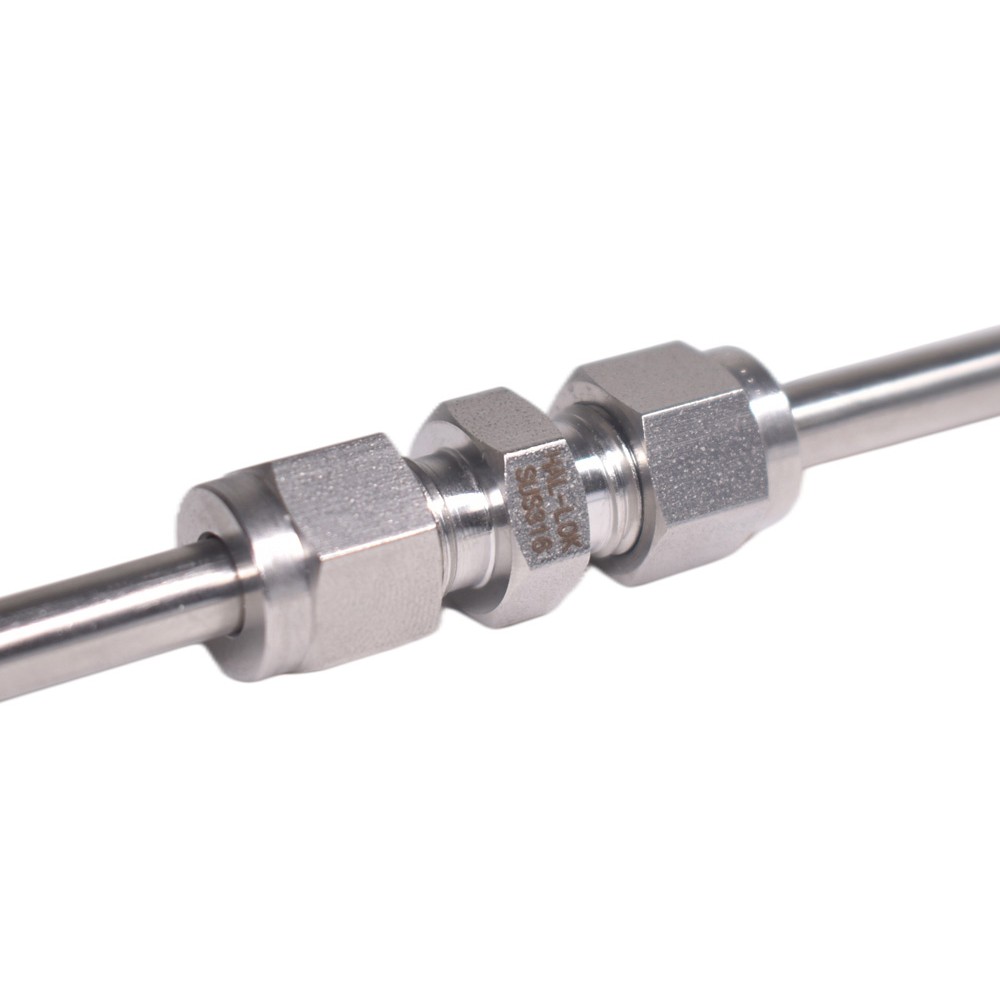
If you work with gas panels, instrument tubing, lab gas systems or process pipelines, you’ve surely faced this question: Why is a Swagelok double ferrule fitting 5–6 times more expensive than a domestic equivalent, when they appear almost the same at first glance?
A quick visual check shows matching hex sizes, thread forms and marking positions. But appearances are deceptive. The critical distinctions are hidden in ferrule geometry, material control, repeatability and leak performance. These factors decide whether your tubing system stays tight under pressure, vibration and repeated disassembly.
Both domestic and Swagelok fittings are stamped 316 stainless steel. However, “316” is only a material specification range, not a quality guarantee.
Swagelok uses certified bar stock from qualified, fixed mills. Each batch comes with full traceability: heat number, chemical composition, grain structure and hardness records. Hardness is tightly controlled for the ferrules — the front ferrule must be soft enough to bite uniformly into the tube wall without cutting through it, yet rigid enough to maintain sealing force after multiple assemblies.
Many domestic manufacturers source raw material from multiple suppliers. Batch-to-batch hardness fluctuation is common. Unstable hardness eliminates standardized torque rules, forcing installers to rely purely on personal experience. Poor thread quality is another frequent issue: some low-cost domestic fittings use hand tapping, creating incomplete, torn thread crests that risk contamination and leakage.
Caption: Cross-section view: Swagelok hinge-style ferrule vs simplified domestic ferrule
The double-ferrule design does not simply mean two ferrules. The front ferrule carries two sealing taper angles: one seals against the fitting body taper, the other bites and seals the outer tube surface. The rear ferrule acts as a spring support, preserving sealing force under vibration and thermal cycling.
Swagelok’s rear ferrule adopts a patented hinge geometry. Once the correct torque is reached, the ferrule stops advancing and prevents over-tightening. Over-tightening is a top failure cause: it collapses the front ferrule and creates permanent grooves on tubing. Many domestic versions simplify the rear ferrule into a straight taper. There is no built-in torque limit. Under-tightening causes leaks; over-tightening destroys the tube and ferrule.
Caption: Torque curve comparison: predictable Swagelok assembly vs inconsistent domestic fitting response
This is the biggest practical gap. Swagelok defines a repeatable assembly procedure: insert tubing fully home, tighten 1¼ turns from finger-tight, verify with a gap gauge. A new technician can learn this in minutes and achieve reliable sealing.
Domestic fittings lack unified torque benchmarks. Even fittings from the same pack may deliver different “stop points”. For small projects assembled by experienced technicians, the risk stays low. For multi-branch gas panels, batch construction and frequent disassembly, inconsistent performance becomes a leak-hunting nightmare.
Swagelok fittings maintain sealing performance after many re-assemblies. Most budget domestic ferrules lose bite force after 2–3 disassemblies. For critical applications, this is a major safety concern. Swagelok validates products per ASTM F1387, covering pressure cycling, vibration, thermal shock and helium leak testing. Most domestic fittings follow GB/T 3765, with only routine hydrostatic sampling. The leak rate gap between 10⁻⁶ and 10⁻⁹ atm·cc/s is an order-of-magnitude difference for UHP gas, hydrogen and vacuum lines.
Caption: Price and lead time comparison for 1/4” 316 SS union fittings
A 1/4” 316 double ferrule union typically costs USD 8–15 for Swagelok, while qualified domestic alternatives sit at USD 1–3. But lead times reverse: Swagelok often requires 2–6 weeks, while reliable domestic suppliers ship from stock quickly.
The premium for Swagelok is not just stainless steel. It buys consistency, traceability, validated performance and application support. A single leak on hydrogen or high-purity gas equipment can trigger shutdown, rework and far higher losses than the fitting cost difference.
UHP gas, semiconductor, hydrogen, vacuum systems: Swagelok or high-grade domestic UHP series
10 MPa working pressure, heavy vibration, frequent rework: Swagelok
Export skids, offshore, certified critical packages: Swagelok with full material test reports
Compressed air, low-pressure water, non-critical utility lines: Qualified domestic fittings are sufficient
Match ferrules and fitting bodies from the same brand. Mixed-brand ferrule-body combinations fail due to taper tolerance mismatch.
Never reuse deformed ferrules that have bitten into tubing.
Require material test certificates and batch traceability for gas service.
Choosing between domestic and Swagelok fittings is not blind brand preference. It is risk-based selection. Use domestic fittings to control costs for low-risk circuits. Invest in validated imported fittings when leakage carries severe consequences. Instrument tubing reliability is always a balance of cost, risk and traceability.