Search for more information
Inert gases such as nitrogen, argon and helium are non‑flammable and non‑toxic. Many operators mistakenly treat them as safe and ignore monitoring requirements. This article explains whether inert gas systems require fixed leak alarms, based on hazard logic, risk assessment and practical installation rules.
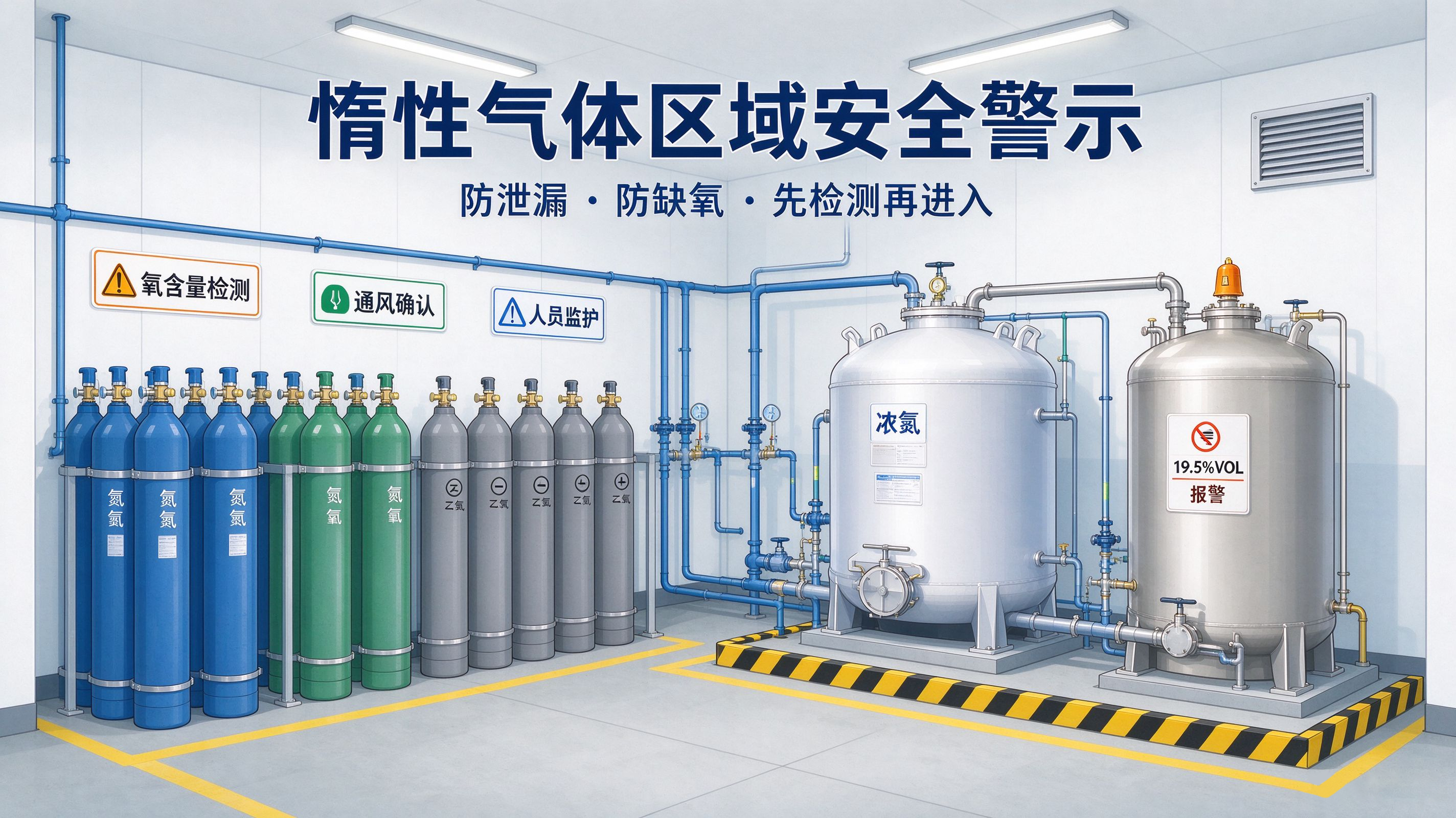
The first key point for safety managers is that there is no low‑cost, stable sensor that can directly detect nitrogen, argon or helium. These gases are colourless, odourless and cannot be sensed by human organs. The monitoring device we use on site is actually an oxygen deficiency monitor.
Its working principle is simple: leaked inert gas displaces air and pushes down oxygen concentration in the enclosed space. The oxygen detector indirectly judges inert gas leakage by tracking oxygen levels. When purchasing equipment, you should search for oxygen deficiency monitors instead of “inert gas leak detectors”.
The word “inert” only describes chemical reactivity. It does not mean safe. Asphyxiation caused by inert gas is a silent killer. Human breathing is regulated by carbon dioxide accumulation in blood rather than oxygen shortage. When oxygen drops slowly, workers will not feel short of breath. Early symptoms are only dizziness, fatigue and confusion. Victims may lose consciousness quietly without warning. This invisible risk makes inert gas far more dangerous than many toxic gases with obvious irritation.
Whether to install an alarm system depends on a documented risk assessment, not a blanket rule. Four factors determine the hazard level: total gas inventory, room volume, natural or mechanical ventilation rate, personnel access frequency and escape routes.
A widely accepted three‑tier evaluation framework is used in laboratories, semiconductor workshops and industrial gas stations:
If the worst‑case oxygen concentration remains above 19.5%: low risk. A signed risk assessment may support exemption from fixed monitoring.
If oxygen falls between 18% and 19.5%: additional controls are necessary. Continuous mechanical ventilation, ventilation interlocks and audible‑visual warnings are required. Fixed oxygen alarms are strongly recommended.
If oxygen drops below 18%: fixed oxygen monitoring is mandatory. Operators also need to reduce gas storage quantity and optimise room layout to avoid gas accumulation.
Many fatal accidents happened in small, poorly ventilated cylinder rooms, low‑lying trenches and cryogenic equipment areas. The calculation of oxygen displacement is not theoretical; it directly reflects the risk of sudden leakage.
Not all inert gas piping carries equal risk. Monitoring is mainly required where gas can gather and staff may enter regularly.
These are the highest‑priority areas. Seal failure, loose joints and safety valve popping can release large volumes of gas instantly. Valves and regulators are the most frequent leak points. Even small continuous leaks will build up over hours in enclosed storage rooms.
Liquid nitrogen and liquid argon keep evaporating. Cold gas is denser and sinks to low areas. White vapour clouds are not reliable warning signs. The visible fog may disperse quickly, while oxygen‑poor gas remains trapped in floor drains, pits and trenches. Sudden helium quenching in MRI rooms can discharge massive gas in seconds.
Gas density decides where hazards accumulate. Argon is heavier than air and stays near the floor. Helium is lighter and gathers under ceilings. Nitrogen has a density close to air and spreads evenly. Even a large main room may have a lethal small pit.
Carbon dioxide is sometimes classified with inert gases, but it is physiologically toxic. It cannot be managed only by oxygen monitors. Dedicated infrared CO₂ detectors with occupational exposure setpoints are required.
If you install oxygen monitors, alarm setpoints and sensor positions must match gas density.
Standard oxygen alarm settings:
First low alarm: 19.5% O₂, triggering local audible and visual warnings to remind nearby staff.
Second critical alarm: 18.0% O₂, activating emergency forced ventilation, gas supply shut‑off (where safe) and remote evacuation alerts.
High oxygen alarm: 23.5% O₂, mainly for sites with oxygen piping in the same gas farm.
Sensor placement guidance:
For nitrogen: install probes at breathing zone height, 1.2–1.8 m above the floor.
For argon and CO₂: add extra low‑level probes near floors, trenches and equipment bases.
For helium: mount supplementary probes under ceilings and high enclosure tops.
For cryogenic systems: place probes close to vent outlets and relief lines.
Alarms should have independent backup power. Warning signals need to be visible outside the room entrance, so people know the internal atmosphere is unsafe before opening the door.
Fixed oxygen monitoring is not always compulsory. Exemption must be supported by formal written risk assessment and permanent control measures. Valid exemptions usually meet all of the following conditions:
The space is permanently open or equipped with continuously verified high‑rate mechanical ventilation.
No low pits, trenches or dead corners for heavy inert gas accumulation.
Small gas inventory, closed sealed process loop with low release potential, no bulk cylinder storage inside.
The area is not a confined space, and entry is infrequent.
Even with approved exemption, sites still need regular leak inspection schedules, staff training and SOPs for abnormal pressure drop or fog. A paper assessment cannot replace routine checks.
Statistics show a large share of inert gas asphyxiation deaths are rescuers. When a worker collapses in an oxygen‑deficient room, untrained colleagues rush in to help and become victims themselves.
Alarms give early warning, but they are not enough. Sites must enforce a non‑negotiable rule: no one enters a suspected oxygen‑deficient atmosphere without approved supplied‑air respirators and a standby observer outside. Self‑contained breathing apparatus must be stored near gas rooms and checked regularly.
So, do inert gases need leak alarms? The simple answer is: what we install is oxygen deficiency monitoring, not inert gas‑specific detectors. The decision depends on whether a credible leak can create an oxygen‑deficient zone where personnel may be exposed.
High‑volume storage, enclosed rooms, poor ventilation, cryogenic systems and low‑lying confined spaces normally require fixed oxygen alarms. Open, well‑ventilated and low‑inventory areas may be exempt with formal risk assessment.
Many companies treat inert gases as harmless because they do not burn or poison. This complacency causes preventable fatal accidents. The safest approach is to complete quantitative oxygen displacement calculation, map accumulation zones, set graded alarms and interlocks where required, and embed entry and rescue controls into site safety management.