When it comes to piping systems, the choice between threaded and welded connections can significantly impact performance, safety, and cost. But which one should you choose? Let's break it down.
Understanding Threaded Connections
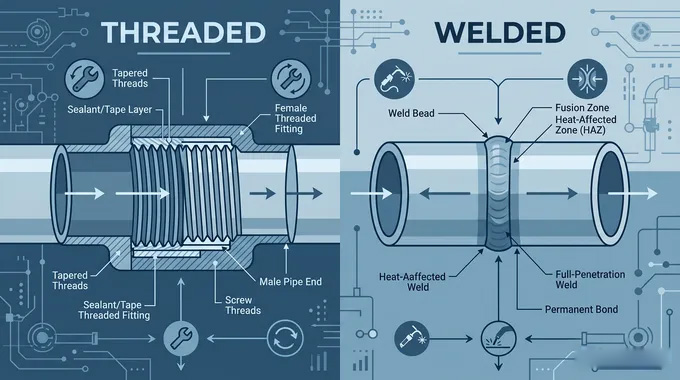
Threaded connections are mechanical joints that use screw threads to join pipes and fittings. They're like the "Lego blocks" of the piping world – easy to assemble and disassemble without special tools.
Advantages of Threaded Connections
Easy Installation and Maintenance
No welding equipment or certified welders needed. You can install threaded connections with basic hand tools, making them ideal for field repairs and modifications.
Disassembly Capability
Need to replace a valve or inspect a section? Threaded connections can be easily taken apart and reassembled, offering unmatched flexibility for maintenance.
Lower Initial Cost
For small-diameter pipes (typically under 2 inches), threaded connections often cost less than welded alternatives when you factor in labor and equipment.
No Heat-Affected Zone
Since there's no welding involved, there's no risk of metallurgical changes or heat distortion in the pipe material.
Limitations
Leak Potential: Threaded joints are more prone to leakage, especially under vibration or thermal cycling
Pressure Restrictions: Generally limited to lower pressure applications (typically below 3000 psi)
Size Constraints: Not practical for large-diameter pipes
Flow Restriction: The internal threading can create turbulence and pressure drop
Understanding Welded Connections
Welded connections create permanent joints by melting and fusing pipe materials together. Think of them as the "permanent marriage" of piping components.
Advantages of Welded Connections
Superior Strength and Integrity
Welded joints can achieve strength equal to or greater than the base pipe material, making them ideal for high-pressure and critical applications.
Excellent Leak Resistance
Properly executed welds provide virtually leak-proof connections, essential for hazardous fluids and high-pressure systems.
Smooth Internal Surface
No internal obstructions mean better flow characteristics and reduced pressure drop – crucial for efficient system operation.
Versatility in Size and Pressure
Suitable for any pipe diameter and pressure rating, from tiny instrument lines to massive transmission pipelines.
Long-Term Reliability
Once properly welded and inspected, these connections can last decades without maintenance.
Limitations
Permanent Connection: Disassembly requires cutting, making modifications difficult and costly
Skilled Labor Required: Certified welders and specialized equipment are necessary
Higher Initial Cost: Welding preparation, execution, and inspection add significant expense
Heat Effects: The welding process can alter material properties in the heat-affected zone
Time-Consuming: Each weld requires preparation, execution, cooling, and inspection
Key Decision Factors
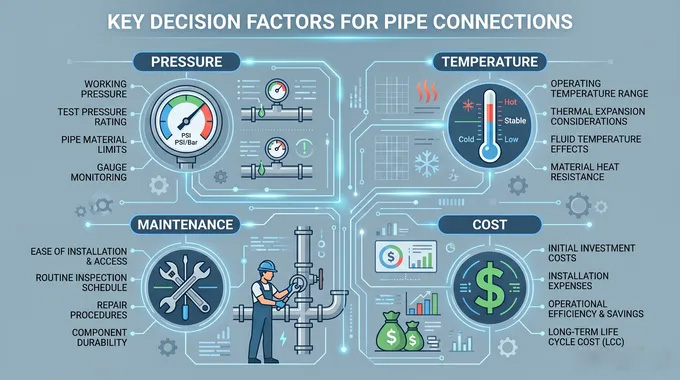
1. Pressure and Temperature Requirements
Choose Welded When:
| Choose Threaded When:
|
2. System Accessibility and Maintenance
Choose Threaded When:
| Choose Welded When:
|
3. Fluid Service Considerations
Choose Welded For:
| Choose Threaded For:
|
4. Economic Analysis
Initial Costs:
Threaded: Lower for small diameters (<2")
Welded: More economical for larger diameters and complex systems
Life-Cycle Costs:
Threaded: Higher maintenance costs over time
Welded: Lower long-term costs due to reduced maintenance
5. Code and Regulatory Requirements
Many industries have specific codes governing connection types:
ASME B31.3: Process piping standards
API standards: Oil and gas applications
Local regulations: May mandate welded connections for certain services
Best Practices for Each Connection Type
For Threaded Connections:
Use proper thread sealants: Teflon tape or pipe dope appropriate for the service
Avoid over-tightening: Can damage threads and cause stress cracking
Support the pipe: Prevent stress on threaded joints from pipe weight
Regular inspection: Check for leaks, especially after thermal cycles
Consider thread reinforcement: Use backing rings for critical applications
For Welded Connections:
Qualified welders only: Ensure proper certification for the material and position
Proper preparation: Clean, bevel, and fit-up according to specifications
Appropriate welding procedure: Follow approved WPS (Welding Procedure Specification)
Non-destructive testing: Radiographic, ultrasonic, or dye penetrant inspection as required
Post-weld treatment: Stress relief or heat treatment when specified
Hybrid Approach: Best of Both Worlds
In many modern systems, engineers use a combination:
Welded main lines: For strength and leak resistance
Threaded branch connections: For instrument taps and maintenance points
Flanged connections: Where disassembly is needed but welding isn't practical
Industry-Specific Recommendations
Oil & Gas
Upstream: Primarily welded for wellheads and production lines
Midstream: Welded for transmission, threaded for instrumentation
Downstream: Mixed approach based on service criticality
Chemical Processing
Critical services: Welded connections mandatory
Utility services: Threaded acceptable for water, air, drains
High-purity systems: Orbital welding preferred
Power Generation
High-pressure steam: Welded exclusively
Cooling water: Threaded acceptable for smaller lines
Instrumentation: Threaded for ease of calibration
Building Services
Fire protection: Welded or grooved per NFPA requirements
HVAC: Threaded common for smaller lines
Plumbing: Threaded standard for most applications
Common Mistakes to Avoid
Using threaded connections in vibration-prone areas: Vibration loosens threads over time
Mixing incompatible materials: Galvanic corrosion between dissimilar metals
Ignoring thermal expansion: Both connection types must accommodate movement
Skipping proper inspection: Especially critical for welded joints
Over-specifying welded connections: Not every joint needs to be welded
Future Trends
The industry is evolving with new technologies:
Advanced threading techniques: Better sealing and strength
Automated welding: Consistent quality and reduced costs
Hybrid connection systems: Combining benefits of both approaches
Smart monitoring: IoT sensors for early leak detection
Conclusion
The choice between threaded and welded connections isn't about which is "better" – it's about which is right for your specific application. Consider:
✓ Operating conditions (pressure, temperature, fluid type)
✓ Maintenance requirements and accessibility
✓ Economic factors (initial vs. life-cycle costs)
✓ Regulatory and code requirements
✓ Safety criticality
When in doubt, consult with experienced piping engineers and follow applicable codes and standards. Remember, the best connection is the one that safely and economically meets your system's needs for its entire service life.
Pro Tip: Document your connection selection rationale! This helps with future maintenance, modifications, and regulatory compliance.