Search for more information
In pipeline systems across oil refining, chemical processing, pharmaceuticals, instrumentation, and even the semiconductor industry, the double ferrule straight connector is an undisputed workhorse — no welding required, easy to install and disassemble, rated up to 69 MPa (10,000 psi), and operable from -53°C to 648°C. It achieves dual sealing through pure mechanical biting, making it one of the most reliable pipe connection solutions available. This article walks you through everything — from working principle to hands-on installation.
The double ferrule straight connector consists of four core components: the fitting body (with a precision internal cone), the front ferrule (an elastic metal ring with a sharp inner cutting edge), the back ferrule (a rigid support ring), and the compression nut.
Its brilliance lies in separating the sealing function from the gripping function, optimizing each independently. When you tighten the nut, the following sequence occurs inside the fitting:
The nut advances mechanically through the threads, pushing the back ferrule forward, which in turn pushes the front ferrule forward.
The fitting body's cone compresses the front ferrule inward, eliminating the tolerance gap between the ferrule's inner diameter and the tube's outer diameter.
As the back ferrule continues to advance, the front ferrule moves forward and inward; its rear end lifts and seats against the fitting body's tapered surface, forming the first seal.
As the tube deforms further and the contact area increases, the greater resistance forces the back ferrule to bite inward, creating a second, firm mechanical grip on the tube.
The entire process requires the nut to rotate just one and a quarter turns (1.25 revolutions) — advancing roughly 1.52 mm — and the fitting completes both sealing and gripping. For small sizes (1/16″, 1/8″, 3/16″, 2 mm, 3 mm, 4 mm), only three-quarters of a turn to the 3 o'clock position is needed.
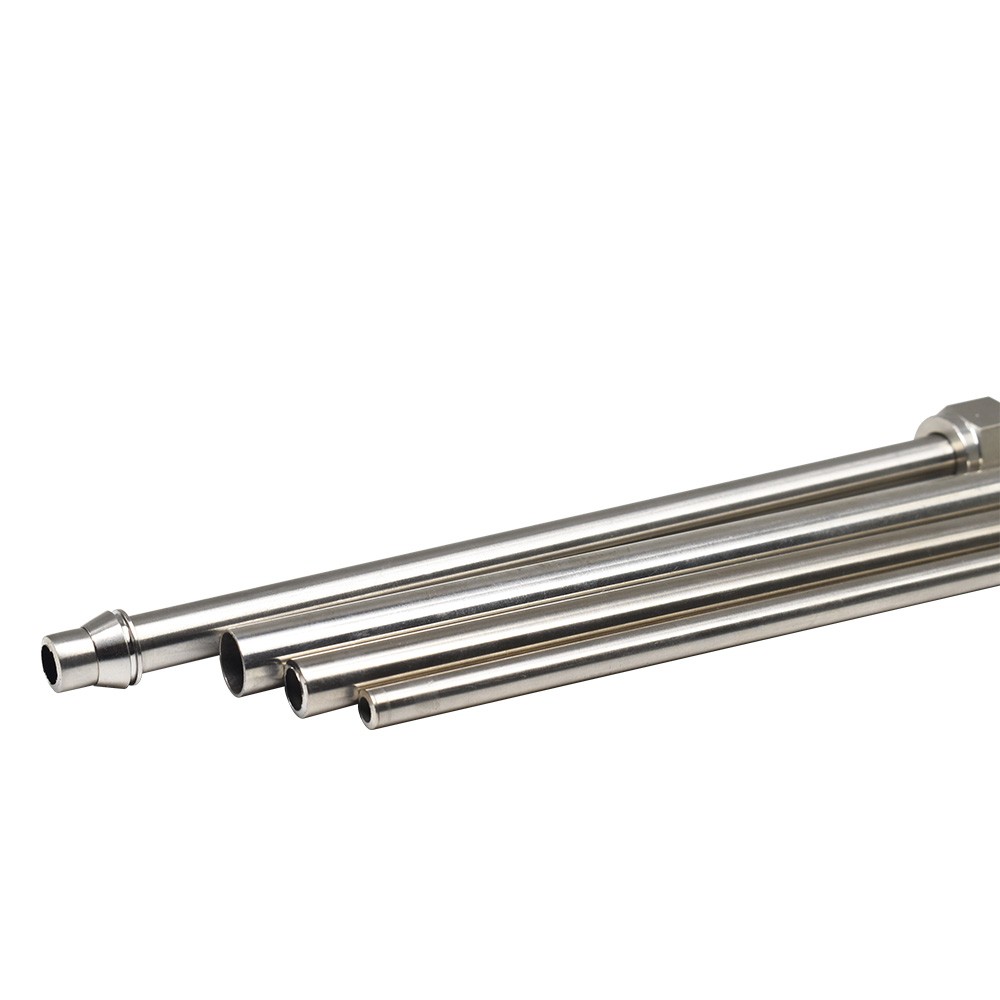
Cut the seamless steel tube to the required length using a dedicated tube cutter (recommended: standard-grade precision, φ4–φ42 mm). The tube end must be perpendicular to the axis, with an angular tolerance no greater than 0.5°. Deburr the end thoroughly with a grinding wheel — it must be flat and free of burrs. The tube surface where the ferrule will seat must be smooth and flawless: no scratches, dents, or raised areas. Any surface defect makes sealing extremely difficult, especially with gas media.
If bending is required, the straight section from the tube end to the bend must be no less than three times the nut length. Clean the tube with high-pressure air and keep it contamination-free throughout.
Slide the nut and ferrules onto the tube in this order: nut on the outside, back ferrule in the middle, front ferrule closest to the tube end. The two ferrules are not interchangeable — installing them backward will cause seal failure. For a one-time assembly, you can loosen the nut about 1/4 turn to make sliding easier, but ensure both ferrules are present and correctly positioned before final tightening.
Apply machine lubricant to the fitting threads and the ferrule. Insert the tube into the fitting body — push it all the way in until it bottoms out against the internal shoulder. Hand-tighten the nut until it stops, and mark the nut at the 6 o'clock position.
A critical tip: pre-assemble using the same type of fitting body that will be used in the final installation. Cone depth can vary between manufacturers or even between batches from the same manufacturer. Mismatched pre-assembly is a hidden cause of leaks.
Hold the fitting body firmly (do NOT rotate the body). Use a wrench to tighten the nut an additional 1¼ turns, moving the mark from 6 o'clock to 9 o'clock. For small sizes, tighten ¾ turn to the 3 o'clock position.
You will feel a distinct torque increase during tightening — this is the "pressure point," indicating the ferrule has bitten into the tube. After reaching the pressure point, an additional ½ turn is sufficient. Reference tightening torques: φ6–10 mm → 64–115 N·m; φ16 mm → 259 N·m; φ18 mm → 450 N·m.
Only on the first installation, insert the gap gauge between the nut and the fitting body. If the gauge cannot be inserted, the fitting is fully tightened. If it slides in, continue tightening.
After pre-assembly, disassemble and inspect: the visible bite mark on the ferrule edge must fill the ferrule end face completely. The ferrule should rotate slightly but not shift axially — this confirms correct pre-assembly.
| # | Rule | Consequence |
|---|---|---|
| 1 | Never use thread sealant | Sealant gets flushed into the system, clogs orifices, and causes failure |
| 2 | Tube must bottom out | Incomplete insertion is the #1 cause of leaks |
| 3 | Do not mix materials | The tube must be softer than the fitting; e.g., never pair stainless steel tube with a brass fitting |
| 4 | Avoid lateral forces | The pipeline must not bear side loads, or the seal fails or fatigues |
| 5 | Tighten once — avoid repeated disassembly | Multiple cycles drastically reduce sealing performance |
| 6 | Remark for reassembly | Draw a line on the tube behind the nut; return the nut to the same position on reassembly |
Other common leak causes after installation: tube not bottomed out, nut under-tightened, scratched tube exterior, out-of-round tube, or tube material too hard. Tube dents and surface defects are the biggest enemy of gas-tight seals — always use matte-finish tubing or ensure surface quality meets spec.
Always depressurize the system before disassembly. Mark the tube behind the nut and draw a reference line on both the nut and the fitting body. On reassembly, hold the fitting body firmly and turn the nut to the marked position — you will feel a clear increase in resistance. If the fitting has been disassembled multiple times, rotate an additional 10°–20°.
Never use a loosened nut or plug to bleed the system. Never install or tighten a fitting under pressure.
Double ferrule straight connectors appear everywhere — oil and gas pipelines, pharmaceutical CIP cleaning systems, semiconductor ultra-pure water delivery, hydraulic systems, and even LNG cryogenic transfer (seals reliably down to -200°C). 316L stainless steel resists H₂S corrosion; Hastelloy handles strong acids; Hastelloy C276 tackles sulfuric and hydrochloric acid in extreme conditions. From lab instruments to aerospace plumbing, it delivers what industrial connections should: no welding, no fire risk, vibration-resistant, pressure-rated — simple, reliable, done right the first time.