In the field of industrial fluid control, stainless steel ferrule straight-through needle valves and ball valves are two widely used precision valves. Both utilize ferrule connections, offering advantages such as easy installation, reliable sealing, and corrosion resistance. They are extensively applied in precision piping systems across the chemical, power, oil and gas, and laboratory industries.
However, due to fundamental differences in their structural design and working principles, they differ significantly in product features, applicable scenarios, usage precautions, and maintenance. Correctly distinguishing these differences is crucial for proper selection, installation, and stable equipment operation.
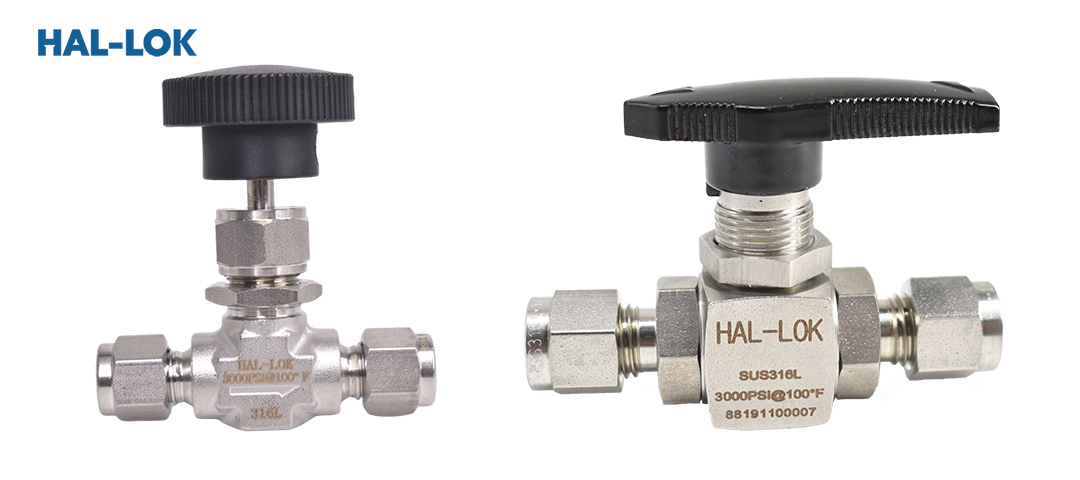
I. Product Features: Spool Structure Determines Core Function
The differences in product features between stainless steel ferrule straight-through needle valves and ball valves stem primarily from their spool structures, which further extend to flow control, sealing performance, and operation methods.
Needle Valve: Precision Adjustment
The spool features a needle-like structure, forming a line-contact seal with the valve seat for a compact design. The core advantage is high flow regulation precision, enabling linear adjustment from micro to medium flow rates. It uses a metal hard seal with an extremely low leakage rate (≤1×10⁻⁶ mbar·L/s), offering excellent vibration and high-temperature resistance. The maximum working pressure can reach 6000 psi (414 bar), with a temperature range spanning -54℃ to 648℃.
Ball Valve: Rapid On/Off
The spool is spherical with a through-hole matching the pipe diameter. The core advantage is minimal flow resistance, allowing fluid to pass through almost unhindered, making it ideal for large-flow transport. Utilizing soft or hard seals, it is quick and light to operate; a 90° rotation completes opening or closing. However, its regulation performance is weak, only suitable for rough flow adjustment.
II. Working Principle: Linear Engagement VS Rotary On/Off
The difference in their working principles essentially lies in the movement of the spool and the sealing mechanism.
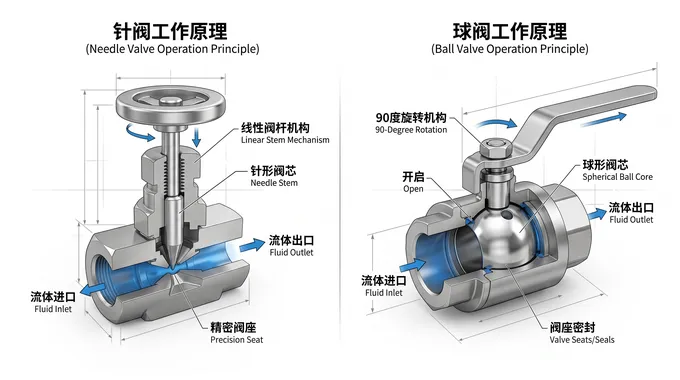
Needle Valve: Linear Lifting
Rotating the handle drives the valve stem in an axial linear motion, changing the gap between the needle spool and the valve seat to achieve precise flow regulation.
Ball Valve: 90-Degree Rotation
When the handle is rotated 90°, the spool's through-hole aligns with the flow channel to open it; rotating 90° in the opposite direction blocks the fluid to close it. Sealing relies primarily on the seals between the spool and the valve seat.
III. Application Scenarios: Micro-Regulation VS Macro-Transport
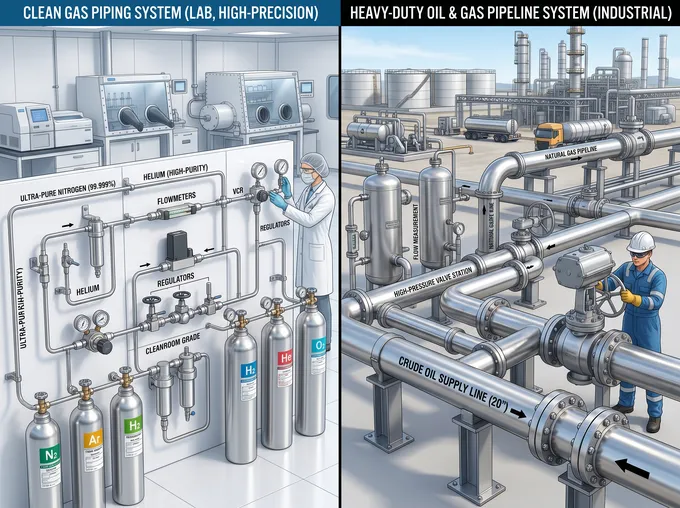
Needle Valve Scenarios
Working conditions requiring precise flow regulation, micro-flow control, high pressure, high temperature, and corrosive media. Examples: laboratory gas systems, petrochemical high-pressure sampling lines, and semiconductor high-purity chemical delivery.
Ball Valve Scenarios
Working conditions requiring rapid on/off, large-flow transport, and frequent operation. Examples: oil and gas LNG pipelines, chemical large-flow acid/base transport, water treatment, and machinery hydraulic systems.
IV. Usage Precautions: Operational "Red Lines"
Needle Valve: Avoid "Rush" and "Force"
1. Slow Operation: Avoid excessive force to prevent water hammer effects.
2. No Forced Adjustment: Forcing adjustment while fully closed will damage the spool and seat.
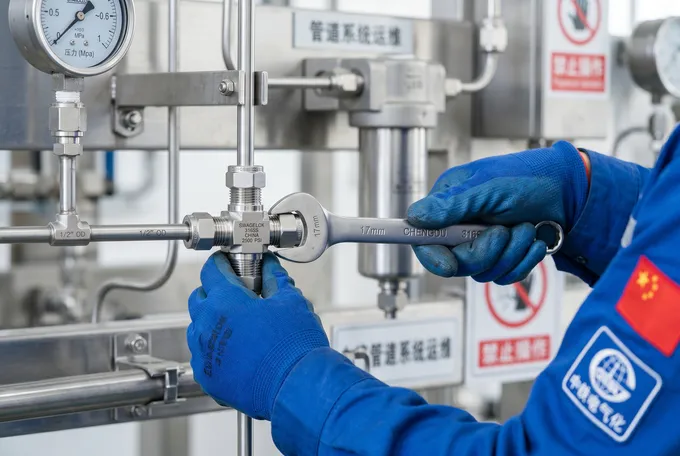
3. Proper Tightening:- Finger-tighten the ferrule, then use a wrench for 1-1.25 turns. Do not overtighten.
Ball Valve: Avoid "Half-Open"
1. Complete Operation: The handle must be fully rotated (90°). A half-open state is strictly prohibited as it wears out seals and causes leaks.
2. Impurity Prevention: Install filters when transporting media with impurities to prevent jamming.
3. Temperature Limit: Soft-sealed ball valves generally should not exceed 150℃.
V. Maintenance Differences
Needle Valve Maintenance
Regularly check packing tightness (replace PTFE packing every 6-12 months); inspect spool and seat wear, replace and recalibrate if precision drops; slightly open periodically during long-term non-use to prevent sticking.
Ball Valve Maintenance
Regularly check soft seals for aging and wear; check stem flexibility and add lubricant if necessary; keep in the open position during long-term non-use to prevent sticking.
Summary of Core Differences
| Dimension | Stainless Steel Ferrule Needle Valve | Stainless Steel Ferrule Ball Valve |
|---|---|---|
| Core Function | Precision Adjustment | Rapid On/Off |
| Flow Control | High precision, linear | Very weak, rough only |
| Flow Resistance | High (micro/medium flow) | Minimal (large flow) |
| Operation | Multi-turn slow rotation | 90-degree fast on/off |
| Typical Scenarios | Labs, high-pressure sampling, semiconductors | Oil & gas, large-flow chemical lines |
In industrial selection, it is essential to consider factors like working pressure, temperature, media characteristics, flow requirements, and operation frequency to clarify the differences between the two. They complement each other, adapting to different fluid control needs, and together form a vital part of industrial precision fluid control.