In the complex circulatory system of modern industrial and laboratory infrastructure, gas supply networks act as the vital arteries. At the very heart of these networks lie pressure regulators—unsung mechanical gatekeepers whose performance directly dictates the stability of gas pressure, the precision of downstream processes, and the paramount safety of the entire operational environment.
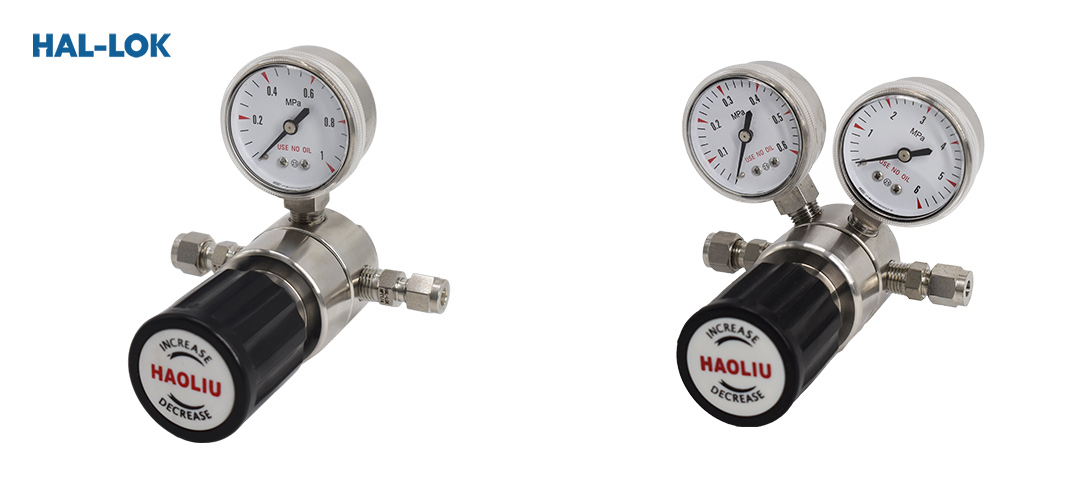
When dealing with high-purity, corrosive, or high-pressure gases, standard brass components often fall short. Enter the realm of stainless steel pressure regulators. Renowned for their exceptional corrosion resistance and high-pressure tolerance, they have become the gold standard in petrochemicals, advanced laboratory analysis, semiconductor manufacturing, and critical medical life-support systems.
However, a critical decision awaits engineers and facility managers during system design: Should you specify a Single-Stage Dual-Gauge regulator or a Two-Stage Single-Gauge regulator? While they may appear similar to the untrained eye, their internal architecture, performance capabilities, and ideal use cases differ profoundly. This comprehensive guide will dissect these two engineering marvels across five critical dimensions, providing you with the technical clarity needed to make informed, fail-safe decisions.
1. The Core Mechanics: Unpacking the Operating Principles
To truly understand the capabilities of these devices, we must first look under the hood at the fluid dynamics and mechanical principles governing their operation.
Single-Stage Dual-Gauge: The Direct Throttling Approach
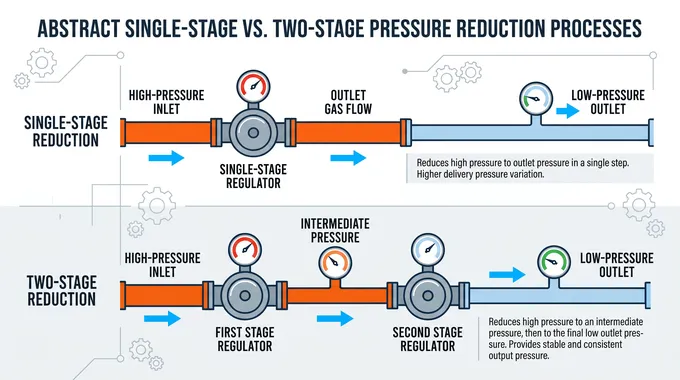
The single-stage regulator operates on a fundamental throttling principle. High-pressure gas from the cylinder enters the regulator's high-pressure chamber. It is then forced through a microscopic, precisely engineered gap between the poppet and the valve body into the low-pressure chamber. This sudden expansion achieves the initial pressure reduction. By turning the external pressure adjustment screw, the operator compresses a heavy-duty spring, which in turn manipulates the diaphragm to change the gap size between the poppet and the valve seat. This single, direct mechanical action dictates the final outlet pressure. The dual gauges serve a distinct purpose here: the high-pressure gauge acts as a "fuel gauge" for the cylinder's remaining capacity, while the low-pressure gauge provides real-time feedback on the throttled output.
Two-Stage Single-Gauge: The Precision Series
If the single-stage regulator is a blunt instrument, the two-stage regulator is a precision scalpel. It features a sophisticated two-stage series pressure reduction design engineered to eliminate the "supply pressure effect" (where output pressure creeps up as the cylinder empties). The first-stage pressure reducing valve handles the heavy lifting, taking the extreme high-pressure gas and reducing it to a stable, predetermined medium pressure (commonly around 2 MPa). This internally regulated gas then feeds directly into the second-stage valve. Because the second stage is fed a consistent medium pressure regardless of the cylinder's actual fullness, it can utilize a highly sensitive, oversized diaphragm to fine-tune the gas down to the exact target pressure (e.g., 0.01–0.1 MPa). Since the intermediate pressure is mechanically fixed and irrelevant to the end-user, only a single low-pressure gauge is required to monitor the final, highly stabilized output.
2. Anatomy and Performance: A Structural Comparison
The structural design and material selection of a regulator determine its operational lifespan and suitability for harsh environments.
Structural and Material Engineering
Both regulators utilize premium materials to ensure integrity. The main bodies are typically forged or machined from 316L stainless steel, a molybdenum-alloyed steel that offers superior resistance to pitting and crevice corrosion. The diaphragms are also crafted from 316L stainless steel to prevent gas permeation, while the valve seats utilize PTFE (polytetrafluoroethylene) for exceptional chemical inertness and high-temperature resilience.
The physical layout, however, differs. The Single-Stage Dual-Gauge regulator features a more compact, straightforward housing to accommodate the two gauges. In contrast, the Two-Stage Single-Gauge regulator often has an elongated or bulkier profile to house the dual internal valve mechanisms and the specialized high-sensitivity diaphragm of the second stage.
Performance Metrics and Stability
Single-Stage Regulators offer a wide input pressure range (up to 250 bar) and a broad flow adjustment range. They boast impressive leak integrity. However, their output is inherently subject to minor fluctuations as the source pressure drops.
Two-Stage Regulators share similar input capacities but excel in output stability. The dual-chamber design virtually eradicates output fluctuation. For instance, an inlet pressure drop of 0.1 MPa might result in an outlet pressure change of a mere 0.0004 MPa. This microscopic variance is the defining characteristic that justifies their use in hyper-sensitive applications.
3. Field Guide: Installation and Maintenance Best Practices
Even the most precisely engineered regulator will fail if improperly installed or neglected. The differing architectures dictate specific handling procedures.
Single-Stage Dual-Gauge Procedures
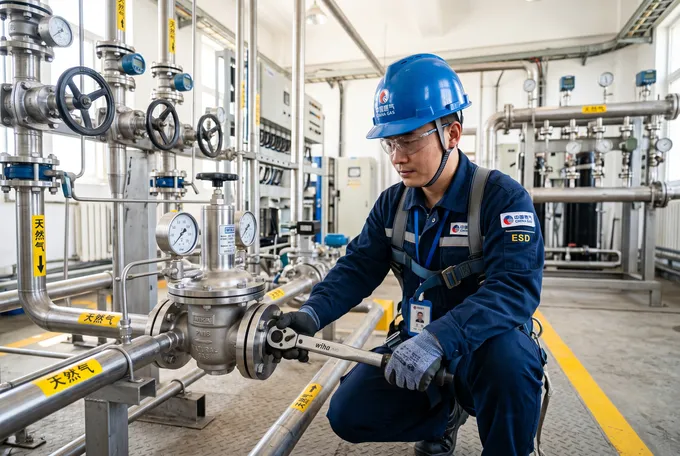
Typically installed directly at the cylinder outlet or at the very front end of a gas distribution manifold to monitor the source pressure via the high-pressure gauge. Before threading the regulator, technicians must briefly "crack" the cylinder valve to blow out any microscopic debris from the valve port. Installation requires a specialized wrench to achieve the manufacturer's specified torque (usually 30–40 N·m) to ensure a leak-proof metal-to-metal seal.
Maintenance involves routine gauge checks, monthly dry-air purging to remove internal dust, and annual professional ultrasonic cleaning.
Two-Stage Single-Gauge Procedures
Often positioned closer to the point of use—at the end of a pipeline or immediately before a sensitive instrument's inlet—to minimize pressure drops caused by long-distance transmission. Crucially, these must be mounted vertically to prevent gravitational bias on the sensitive second-stage diaphragm.
Maintenance demands a more rigorous regimen. Technicians must meticulously inspect the second-stage diaphragm for metal fatigue. Upstream sintered filter screens must be replaced regularly. If decommissioned, the regulator must be completely purged with an inert gas to prevent internal corrosion.
4. Safety First: Usage Precautions and Emergency Protocols
Handling highly compressed gases is inherently hazardous. Understanding the specific operational quirks of your chosen regulator is a matter of life and safety.
Single-Stage Dual-Gauge Safety
A universal rule is the slow opening of the cylinder valve to prevent adiabatic compression, which can instantly spike temperatures and ignite trace hydrocarbons, leading to explosions. Regulators used for oxygen service must be strictly maintained in an "oil-free" condition.
If an oxygen-fueled fire occurs due to oil contamination, only dry powder extinguishers are permissible (water or foam can exacerbate specific chemical fires).
Two-Stage Single-Gauge Safety
The slow-opening rule is critical here to prevent physically rupturing the delicate second-stage diaphragm. When switching cylinders, operators must rigidly follow the protocol of closing the regulator's outlet valve before decoupling the cylinder.
A common operational hazard in high-flow scenarios is "freezing" due to the Joule-Thomson effect. If it freezes, it must be gently thawed using warm water (below 40°C). The use of open flames or industrial heat guns is strictly prohibited, as it will destroy the PTFE seals.
5. Matching Tech to Task: Application Environments
The ultimate choice between these two regulators comes down to the specific demands of the application environment. Over-engineering wastes budget, while under-engineering compromises the process.
The Domain of the Single-Stage Regulator
Ideal for scenarios with standard pressure stability requirements:
Laboratory Gas Distribution: Serving as the primary pressure reduction point at the cylinder.
Heavy Industrial Gas Supply: Acting as the first line of defense at the front end of massive factory pipelines.
Medical Manifolds: Utilized in hospital oxygen rooms to provide a continuous, reliable low-pressure feed to life-support ventilators.
The Domain of the Two-Stage Regulator
Deployed wherever microscopic pressure fluctuations translate to massive financial losses or invalid data:
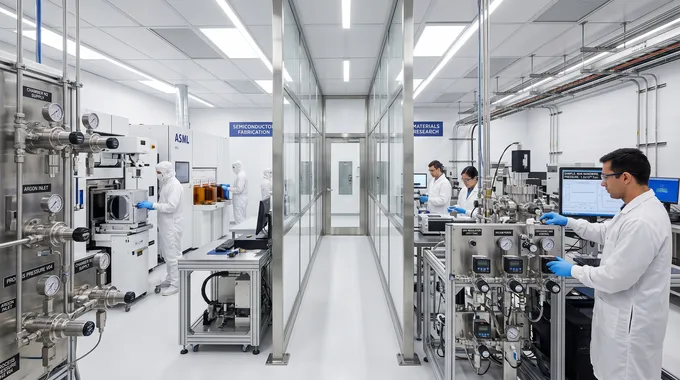
Semiconductor Manufacturing: In cleanrooms where process gases must be delivered with absolute consistency.
Advanced Analytical Instruments: Gas chromatographs (GC) and mass spectrometers (MS) rely on exact carrier gas flow rates.
Modified Atmosphere Packaging (MAP): Precisely controlling the pressure of Nitrogen or Carbon Dioxide to displace oxygen without bursting the packaging.
Conclusion: The Engineering Verdict
The stainless steel single-stage dual-gauge and two-stage single-gauge pressure regulators are not competing products, but rather complementary tools designed for distinct engineering challenges.
The single-stage regulator champions structural simplicity, economic efficiency, and broad utility, making it the bedrock of general gas distribution. The two-stage regulator, through its ingenious series-reduction architecture, trades a higher initial investment for uncompromising output stability, serving as the critical enabler for high-tech manufacturing and precision analysis.
For industrial professionals, the mandate is clear: rigorously assess the pressure tolerance of your downstream processes. Select the single-stage for robust, general-purpose reduction, and reserve the two-stage for applications where precision is non-negotiable.