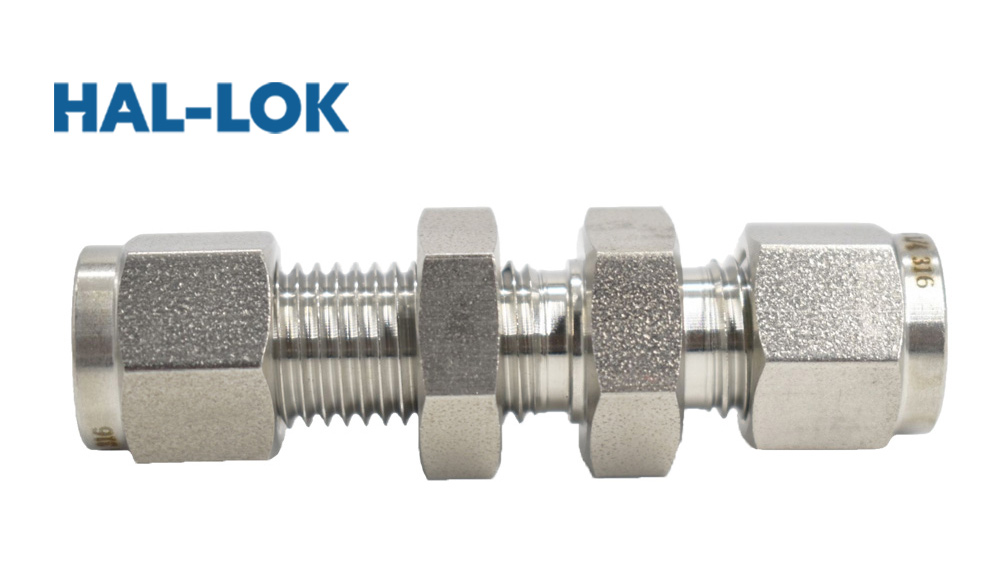
Targeting industrial engineers, plant managers, and procurement specialists: In the complex arteries of modern industrial infrastructure, the integrity of a piping system often comes down to its smallest components. For those operating in high-stakes environments like petrochemicals, pharmaceuticals, and advanced water treatment, a single leak is not merely a maintenance issue—it is a potential catastrophic failure. Enter the stainless steel compression fitting through-wall connector. Far from being a simple joint, this component represents a sophisticated synthesis of metallurgy, fluid dynamics, and precision engineering, designed to guarantee absolute reliability under the most punishing conditions.
Technical Innovation: Dual Breakthrough in Mechanical Sealing and Materials Science
The unparalleled reliability of modern stainless steel compression fittings is rooted in a fundamental re-engineering of how metal interacts with metal under extreme stress. This is not merely about holding two pipes together; it is about creating a continuous, impermeable barrier.
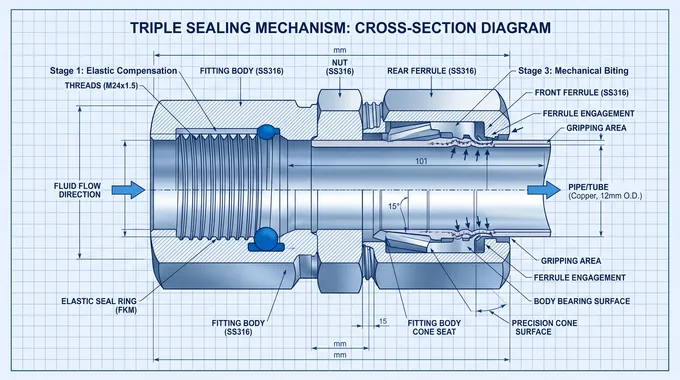
Triple Sealing Mechanism
• Mechanical biting: Front edge uniformly cuts into pipe wall (0.1-0.2mm depth) for metal-to-metal hard seal.
• Cone sealing: Outer cone surface tightly fits inner cone, creating second barrier; maintains zero leakage at 10MPa for 24 hours.
• Elastic compensation: Arch-shaped design automatically compensates gaps under vibration; fatigue life increased from 5,000 to 20,000 cycles with rubber buffer.
Material Adaptation: From Extreme Environments to Hygiene Standards
• Corrosion resistance: 316L stainless steel withstands chloride concentrations >200ppm; corrosion rate reduced from 0.3mm to 0.05mm/year with PTFE coating.
• Temperature range: Double ferrule structure with alloy steel nuts covers -196°C to 450°C; continuous operation extended to 3 years.
• Hygiene standards: 304 stainless steel with Ra≤0.8μm surface roughness meets CIP/SIP requirements; microbial compliance rate improved to 99.99%.
Application Scenarios: Cross-Industry Connection Solutions
The true value of a technology is proven in the field. Across distinctly different industrial landscapes, these connectors solve highly specific operational challenges.
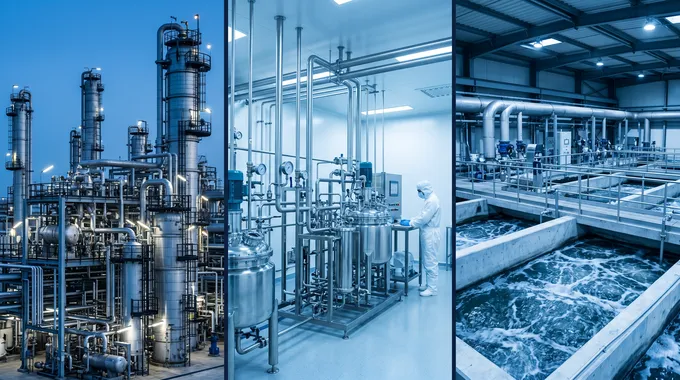
Petrochemical Industry
Built to withstand extreme high temperature and pressure, routinely handling working pressures up to 63MPa. Leakage rates plummeted from 0.3% to 0.01%, directly translating to a 40% reduction in maintenance costs. In explosion-proof environments, the weld-free installation process entirely eliminates the risk of sparks—a critical safety feature that helped one offshore platform save $6 million in maintenance over five years.
Food & Pharmaceutical Industry
Clean production is non-negotiable. Using 316L material subjected to electropolishing achieves a surface roughness of 0.4μm, preventing microbial growth and making it a key compliance element for FDA certification. The need for frequent disassembly is addressed by quick-connect designs, reducing production line maintenance time from 72 hours down to 24 hours.
Water Treatment Systems
The all-metal structure provides excellent corrosion and clog resistance against aggressive chlorides. The 0.4μm internal smoothness lowers pressure drop by 15%, yielding up to $200K in annual energy savings. For outdoor applications like photovoltaic stations, nylon fittings with carbon black additives extend service life to 10 years.
Maintenance Standards: Ensuring Long-Term Performance
Even the most precisely engineered component will fail if installed or maintained improperly. A rigorous adherence to standardized protocols is essential.
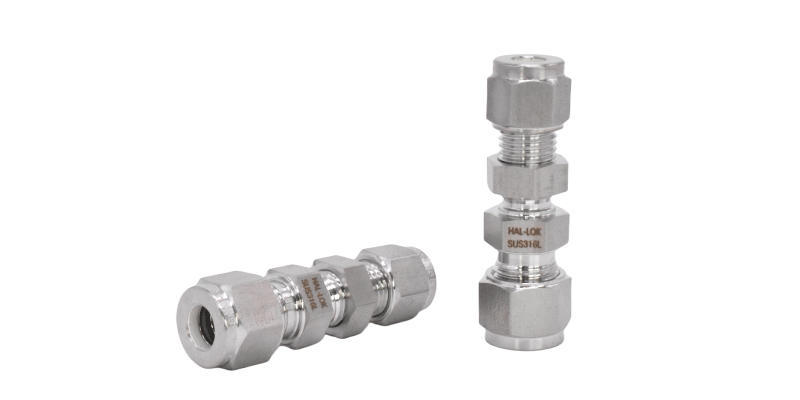
Installation Specifications
Pre-assembly: Hydraulic pre-assembly machine controls torque precision within ±5%; qualification rate improved from 78% to 99%.
Coaxiality control: Pipe end flatness ≤0.05mm; burrs cause pulse leakage—use specialized pre-assembly tools.
Torque standards: Stainless steel 15-20N·m, copper alloy 8-12N·m; avoid overtightening.
Routine Maintenance
• Leakage inspection: Check internal leaks via drain port; follow 'Three No's': no sealant, no lateral force, no more than 5 reassemblies.
• Lubrication: Inject lubricant equal to 1/8 of seal system volume after each operation on frequently used fittings.
• Anti-corrosion: Reapply coating every 2 years for outdoor fittings; PTFE coating reduced corrosion rate by 83%.
Usage Guidelines: Full Lifecycle Control
Material Matching Principles
• Medium compatibility: Use 316L for chloride-containing media, PFA/PVDF for ultrapure water, double ferrule for high-pressure hydraulic systems.
• Temperature matching: Austenitic stainless steel for <-196°C, nickel-based alloys for >450°C.
Installation Prohibitions (WARNING)
• Pipe requirements: Avoid thin-walled pipes; d8-15mm needs >1mm wall thickness, d16-18mm needs >1.5mm to prevent deformation.
• Cutting standards: Use sawing machines or specialized cutters only; prohibit grinding wheel cutting to prevent cracks or metal debris.
• Environmental control: Consider UV aging for outdoor installations; carbon black-enhanced nylon extends life to 10 years.
Failure Prevention
• Leak troubleshooting: Check if pipe is fully inserted, nut tightness, surface scratches, or ovality out of tolerance.
• Vibration response: Add rubber buffers or vibration-damping brackets in vibrating conditions; fatigue life increased by 300%.
Future Trends: Integration of Intelligence and Green Manufacturing
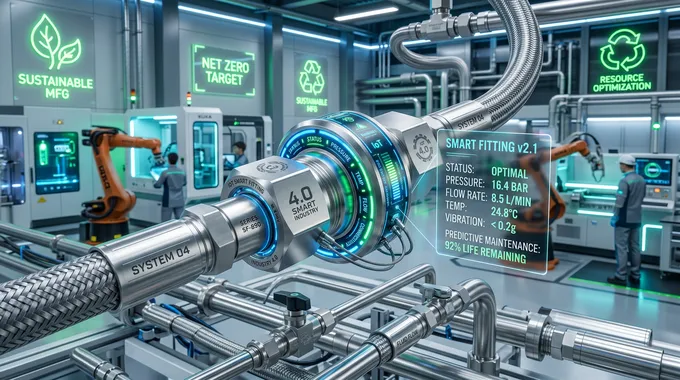
With Industry 4.0 development, smart compression fittings are entering R&D:
• IoT integration: Self-diagnostic fittings achieve 0.1ml/min leak detection accuracy with <0.1% false alarm rate.
• Green manufacturing: Optimized design reduces weight by 20%, carbon emissions by 15%, with 95% recyclability becoming industry standard.
From deep-sea oil extraction to spacecraft life support systems, stainless steel compression fitting through-wall connectors continue to safeguard modern industrial safety through mechanical sealing innovation, materials science breakthroughs, and standardized maintenance systems. As intelligent technology and green manufacturing deepen their integration, this traditional connection component is gaining new vitality, becoming an important force driving industrial upgrades.