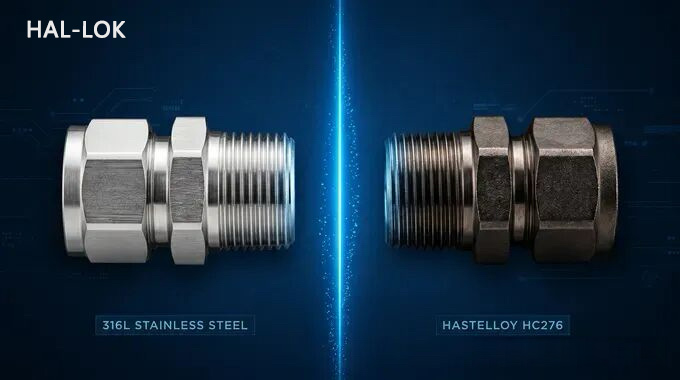
In the complex vascular networks of modern industrial piping systems, the selection of fitting materials is never a mere procurement decision; it is a critical engineering calculation that directly dictates equipment lifespan, operational safety, and long-term economic viability. When transporting highly corrosive, pressurized, or extreme-temperature media, a single fitting failure can cascade into catastrophic plant downtime or severe environmental hazards. At the forefront of this material selection matrix stand two premium metals: HC276 Hastelloy and 316L Stainless Steel. This comprehensive analysis deconstructs these two materials from their microscopic lattice structures to their macroscopic industrial applications, offering a rigorous blueprint for material selection.
I. Product Characteristics: How Elemental Composition Defines Performance Boundaries
The capabilities of any alloy are fundamentally dictated by its metallurgical recipe. The distinction between HC276 and 316L begins in the crucible, where specific elemental additions create distinct performance profiles.
1. The Apex Predator of Alloys: Core Advantages of HC276
HC276 is classified as a nickel-based superalloy, containing approximately 57% nickel, 16% molybdenum, 16% chromium, and 4% tungsten. This specific ratio unlocks three extraordinary characteristics:
Universal Corrosion Resistance: In aggressively corrosive media (hydrochloric acid, sulfuric acid, wet chlorine gas), its corrosion rate is less than 0.01mm/year—one-tenth that of 316L. In flue gas desulfurization (FGD) systems, HC276 fittings routinely operate for over 5 continuous years without replacement.
Extreme High-Temperature Stability: Maintains a formidable tensile strength of 690MPa even at 650°C, indispensable in aerospace and high-temperature chemical reactors.
Unparalleled Stress Corrosion Resistance: In mixed environments containing chloride ions and oxidizing media, its resistance to Stress Corrosion Cracking (SCC) is three orders of magnitude superior to 316L.
2. The Industrial Workhorse: Differentiated Positioning of 316L
As an upgraded evolution of standard austenitic stainless steel, 316L achieves its performance breakthrough via the strategic addition of 2-3% molybdenum:
Economical, Targeted Corrosion Resistance: In weakly to moderately corrosive environments, it doubles the corrosion resistance compared to 304 stainless steel, at approximately 1/8th the cost of HC276. Provides a reliable 15-year service life in coastal infrastructure.
Superior Processing Adaptability: Elongation rate ≥40% allows precise manufacturing of complex shapes. Surface matte treatments reduce friction coefficient by 30%.
The Low-Carbon Welding Advantage: Carbon content ≤0.03% reduces intergranular corrosion risk after welding by 60%, ensuring weld seams remain robust.
II. Working Principle Analysis: Microstructure Determines Macroscopic Performance
1. The Triple-Threat Defense Mechanism of HC276
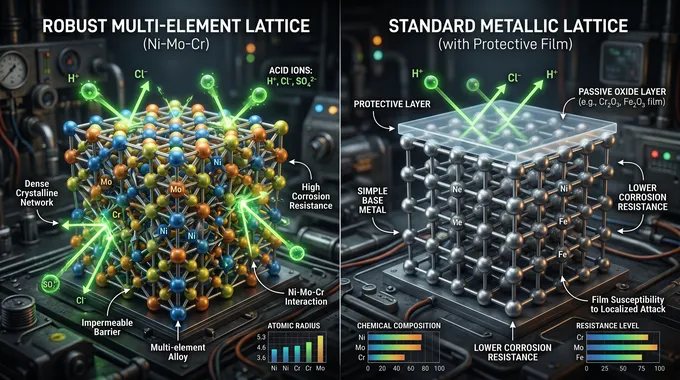
Within its face-centered cubic (FCC) lattice structure, constituent elements form a regenerative, triple-layered defense:
Reducing Media (Molybdenum): Forms a resilient MoO₄²⁻ ion adsorption layer. Passivation film repair rate is 5 times faster than 316L in hydrochloric acid.
Oxidizing Media (Chromium): Generates a dense Cr₂O₃ film. Critical corrosion current density in nitric acid is two orders of magnitude lower than 316L.
Mixed Media Synergy (Tungsten): Promotes stabilization. In sulfuric acid with chloride ions, PREN reaches 65 (vs 316L's 33).
2. The Passivation Logic and Vulnerabilities of 316L
316L utilizes molybdenum to stabilize its chromium-oxide passivation film, operating within strict boundaries:
Chloride Ion Tolerance Threshold: Maintains stability when Cl⁻ concentration <200ppm. Beyond this, the film ruptures locally, leading to pitting.
Weld Zone Protection Mechanics: Low carbon reduces carbide precipitation in HAZ by 80%, but heat input must be controlled below 15kJ/cm to avoid sensitization.
III. Application Environment Matching: Scenario-Based Selection
1. Extreme Frontiers: HC276 Scenarios
Aggressive Strong Acid
Replaces titanium in 20% HCl, reducing costs by 40%. Extends maintenance cycles from 6 months to 3 years.
High-Temp Deep-Sea
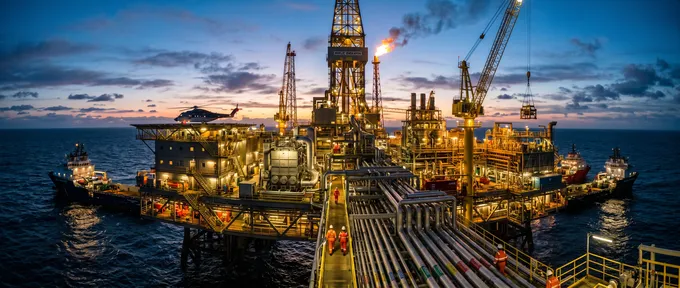
Withstands 150°C, 10MPa, and H₂S/CO₂ sour gas corrosion in offshore extraction.
Nuclear Energy
Radiation resistance ensures up to 60 years lifespan in waste treatment storage tanks.
2. The Broad Spectrum: 316L Scenarios
Marine & Coastal
10+ years corrosion-free in offshore fire water splash zones at 1/5th the cost of Hastelloy.
Food & Pharmaceutical
Ra≤0.8μm surface meets GMP standards for fermentation tanks and purified water pipelines.
Cryogenic Environments
Maintains >34J impact energy at -196°C in liquid nitrogen tanks, preventing brittle fracture.
IV. The Material Selection Decision Model
Material selection requires a rigorous, quantitative approach based on the "Corrosive Media Intensity vs. Temperature/Pressure Rating vs. Cost Sensitivity" model:
[The Extreme Zone] High Corrosion + High Temp/Pressure: Prioritize HC276. Essential for strong acid reactors and deep-sea drilling where failure costs far exceed initial capital expenditure.
[The Economic Zone] Moderate Corrosion + Normal Temp/Pressure: Select 316L. Unbeatable cost-effectiveness for food/beverage pipelines and municipal water supply.
[Special Anomalies] Chemical Kryptonite: Evaluate media thoroughly. E.g., in fluoride ion environments, 316L must be strictly avoided regardless of baseline temperatures.
The debate between HC276 and 316L embodies the "performance-cost" balance in materials science. HC276 is a metallurgical triumph for extreme environments, while 316L represents economical engineering for standard industrial needs.
As Industry 4.0 advances, 3D printing is reducing HC276 costs by 30%, and nano-treatments are boosting 316L resistance by 50%. Ultimately, flawless selection demands a holistic integration of specific operating conditions and lifecycle cost analysis to achieve optimal operational safety and investment returns.