Foreword: In the intricate veins of modern industry—spanning hydraulic systems, pneumatic networks, and diverse fluid transmission pipelines—tube fittings (especially ferrule or compression fittings) serve as the critical junctures. Celebrated for their ease of installation, weld-free assembly, and reusability, they are the unsung heroes of fluid engineering. However, a single compromised fitting can trigger a catastrophic chain reaction. Fluid or gas leakage is not merely a localized mechanical failure; it is a precursor to wasted resources, catastrophic equipment damage, and severe safety and environmental crises. This in-depth article unpacks the root causes of tube fitting leaks and provides a rigorous, actionable framework for detection and prevention, empowering engineers and plant managers to master fluid system safety.
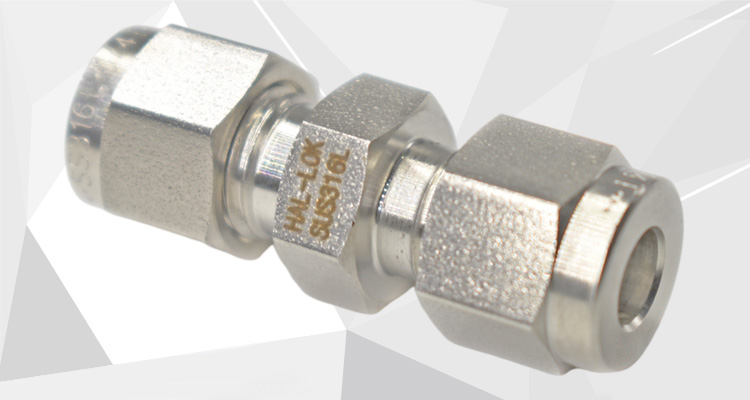
Ⅰ. The Devastating Impacts of Fitting Leaks
A microscopic breach in a fitting can lead to macroscopic disasters. Understanding the multi-dimensional consequences is the first step toward proactive maintenance.
Staggering Economic Losses: A steady leak bleeds operational budgets. In hydraulic systems, the cumulative volume of fluid lost annually due to unchecked leaks is astronomical. Given the premium cost per gallon of specialized hydraulic fluids, chronic leakage translates directly into severe financial hemorrhage. Furthermore, these leaks inevitably precipitate unexpected equipment downtime, multiplying the direct costs through halted production lines and expensive emergency repairs.
Accelerated Equipment Degradation: Fluid loss drastically alters the operational equilibrium of a system. As hydraulic fluid volumes drop, operating temperatures spike, neutralizing the fluid's lubricating properties. This thermal degradation accelerates the wear and tear on internal mechanical components, severely curtailing the equipment's lifecycle. In highly regulated sectors like offshore oil engineering, where operational windows are strictly legislated, equipment failure means missing irreplaceable production timelines, permanently damaging the project's bottom line.
Critical Safety Hazards: The implications for human safety are alarming. In the petrochemical and manufacturing industries, escaping pressurized fluids or flammable gases require only a single ignition source to trigger devastating fires or explosions. Even in non-explosive environments, pooled hydraulic oil creates treacherous, slip-prone work zones, drastically increasing the risk of severe workplace injuries.
Severe Environmental Pollution: Industrial fluid leaks are ecological liabilities. Toxic hydraulic oils seeping into the surrounding soil or local water tables disrupt delicate ecological balances. With global environmental regulations (such as ESG mandates) becoming increasingly stringent, companies responsible for unchecked emissions face crippling punitive fines and irreversible damage to their corporate reputation.
Ⅱ. Root Cause Analysis: Why Do Fittings Fail?
To prevent leaks, we must dissect the mechanical and human factors that cause them. Leaks rarely occur without underlying infrastructural or procedural flaws.
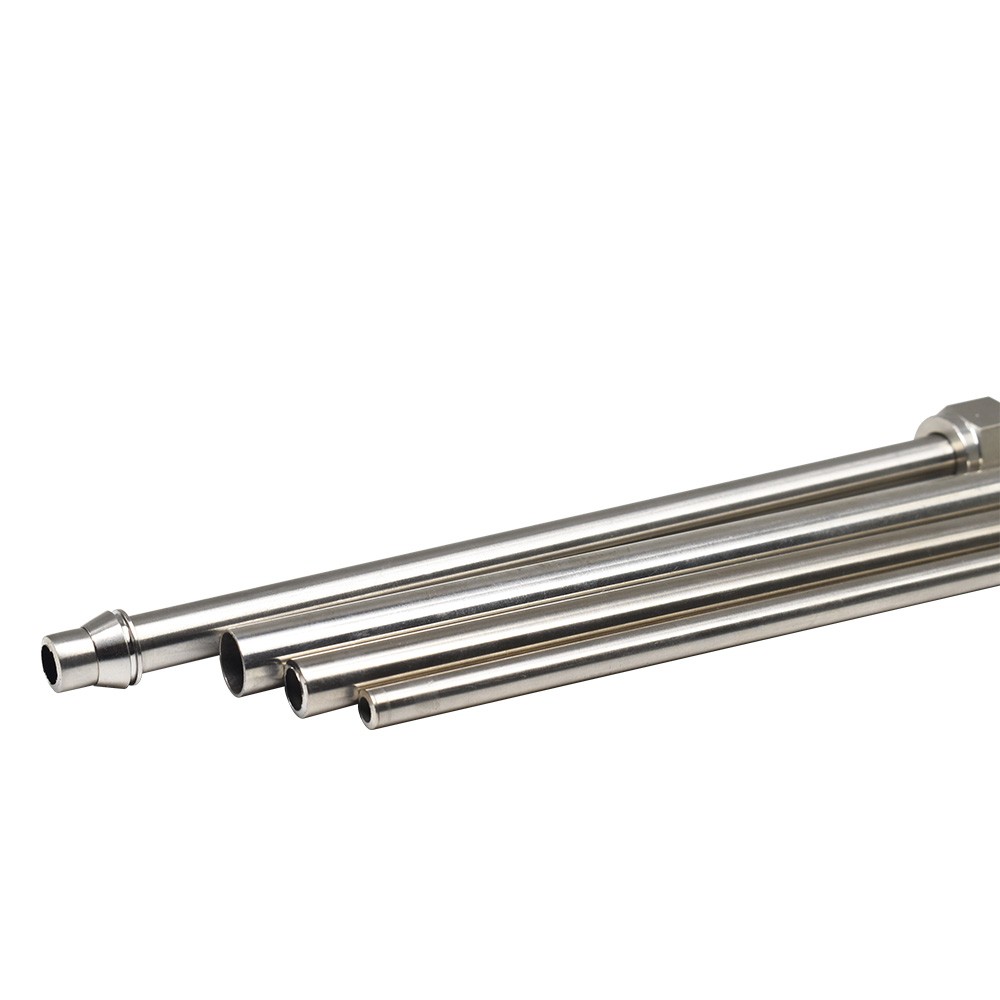
Substandard Tubing Quality: Poor Surface and Material Integrity (e.g., hardened surface layers preventing ferrule bite) and Excessive Ovality create inconsistent contact and microscopic gaps.
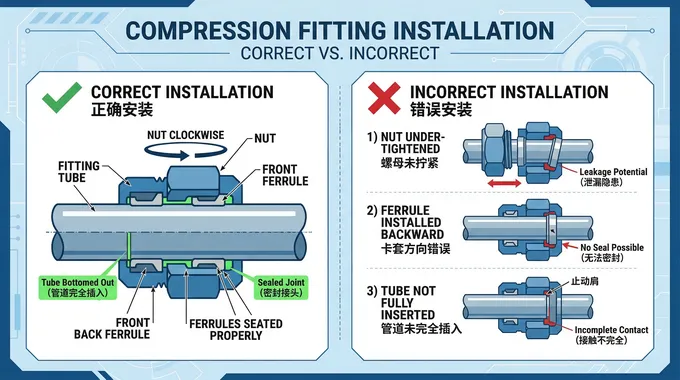
Ferrule Defects and Malfunctions: Manufacturing Flaws (dull or deformed edges) and Improper Installation (incorrect torque, absence of uniform bulge) guarantee eventual leakage.
Machining Inaccuracies in the Fitting Body: Imperfect Conical Surfaces (deviations beyond 24° tolerances) and Thread Discrepancies (mixing standards, rough surfaces) destroy the seal.
Flawed Installation Craftsmanship: Neglecting Pre-assembly Lubrication, Incorrect Torque Application (ignoring standard procedures like the 1-1/4 turn), and Insufficient Tube Insertion are critical human errors.
Destructive External Forces: Mechanical Shock and Vibration, along with Poor Piping Layout (unsupported runs, sharp bends), amplify stress and pull the seal apart over time.
Ⅲ. Effective Leak Detection Methods & Prevention
A robust maintenance protocol requires a multi-tiered approach to leak detection, coupled with uncompromising prevention strategies.
Rigorous Visual and Tactile Inspection: Manually wiggle the tubing, inspect ferrule sharpness and 24° mating surfaces, and safely dismantle joints to verify proper insertion and the presence of a uniform material bulge.
Precision Tool-Based Diagnostics: Utilize calibrated torque wrenches, gap inspection gauges, and conduct pressure drop testing to scientifically verify seal integrity.
Advanced Detection (Snoop & Ultrasonic): Apply Snoop Liquid (Soap Water) testing to reveal active bubbling from microscopic gas leaks, or use Ultrasonic Acoustic Detection to "hear" invisible leaks in high-stakes environments.
Mandate Premium Materials & Machining: Insist on high-precision, cold-drawn seamless tubing and fitting bodies with mirror-smooth 24° conical surfaces.
Standardize Installation Protocols: Enforce mandatory lubrication, strict adherence to manual tightening turns (e.g., 1-1/4 turns), and implement vibration isolation in piping layouts.
Optimize System Architecture & Training: Simplify networks with integrated manifolds, minimize sharp bends, and invest heavily in technician training to understand the physics behind a ferrule bite.
Ⅳ. Real-World Case Studies & Conclusion
Case 1: The Offshore Equipment Paradigm Shift
At an East China offshore equipment base, a hydraulic lifting unit failed due to domestically sourced, under-spec fittings and insufficient crimping pressure. The Solution: Pivoting to a premium supplier with 600-bar tube-end forming machinery, combined with rigorous dimensional inspections and crew retraining, eliminated leaks and safeguarded the maritime deployment.
Case 2: Curing the Machine Tool Hydraulic Bleed
A machine tool manufacturer faced chronic leaks due to a flawed design relying on archaic paper gaskets. The Solution: Overhauling the architecture to use face-seal grooves with high-grade O-rings, tapered pipe plugs, and a redesigned internal casting with an oil return galley. This completely eradicated leaks and extended MTBF.
Conclusion: The integrity of a tube fitting is the absolute foundation of fluid system reliability. The catastrophic potential of compromised fittings demands a zero-tolerance approach. By thoroughly analyzing metallurgical, mechanical, and human factors, and deploying strict detection and uncompromising prevention strategies, organizations can fortify their fluid networks. True operational excellence lies in engineering an ecosystem where leaks are structurally impossible. Let precision, premium materials, and professional training be the bedrock of your fluid system safety.