In the intricate world of industrial fluid control, precision, reliability, and safety are paramount. Whether you are managing a complex petrochemical refinery, overseeing a highly sensitive laboratory instrumentation system, or designing an advanced hydraulic network, the components you choose will ultimately dictate the efficiency and longevity of your entire operation. Among the myriad of components available to engineers and technicians, valves stand out as the critical gatekeepers of fluid management. Specifically, when dealing with high-pressure, leak-tight requirements, ferrule-connected valves—namely, Ferrule Ball Valves and Ferrule Needle Valves—are the undisputed industry standards.
However, a common dilemma frequently plagues both novice engineers and seasoned technicians alike: Which valve should I use, and when? While they may look somewhat similar from a distance and share the same reliable ferrule compression fitting technology, their internal mechanisms, primary functions, and optimal application scenarios are fundamentally different. |
1. Function and Application
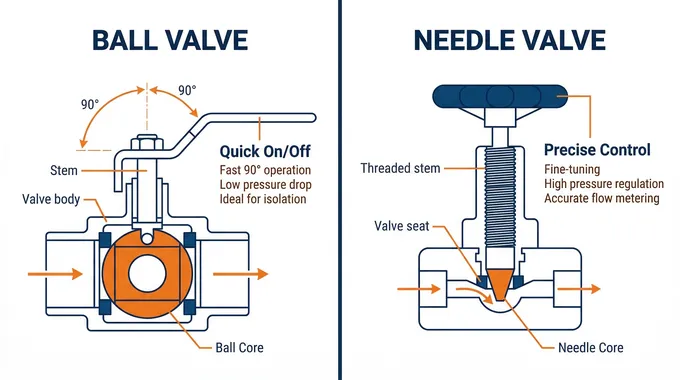
Ball Valve: The ultimate "On/Off" switch. It is designed for rapid isolation and full flow. It possesses zero capability for flow regulation. Ideal for emergency shut-off systems, dirty or slurry media, and high-volume transfer lines. | Needle Valve: The ultimate "Dimmer" switch. It is designed for precise flow throttling and micro-adjustment. Used extensively in instrumentation and measurement, hydraulic systems, and high-pressure, low-volume scenarios. |
2. Operation Mechanism
Ball Valve: Quick and decisive. A mere 90-degree turn of the lever completes the transition from open to closed. Needle Valve: Gradual and continuous. It requires multiple rotations of a handwheel to slowly alter the cross-sectional flow area, allowing for infinite adjustments within its range.
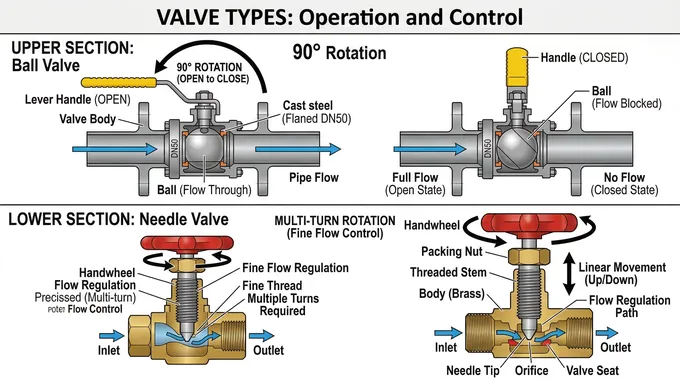
3. Structural Differences
- Ball Valve Internal Structure: Features a spherical core with a straight-through channel. This results in exceptionally low fluid resistance (low pressure drop) and prevents the accumulation of debris.
- Needle Valve Internal Structure: Features a tapered plug with a conical sealing mechanism. The fluid path is indirect, intentionally causing a pressure drop to facilitate precise flow restriction.
4. Suitable Scenarios
Choose a Ball Valve when you need to quickly start or stop the flow, move large volumes of fluid, minimize pressure loss, or handle media containing impurities. Choose a Needle Valve when you need to accurately control the exact volume or pressure, work with clean gases/liquids in small-bore tubing, or deal with extreme high-pressure environments.
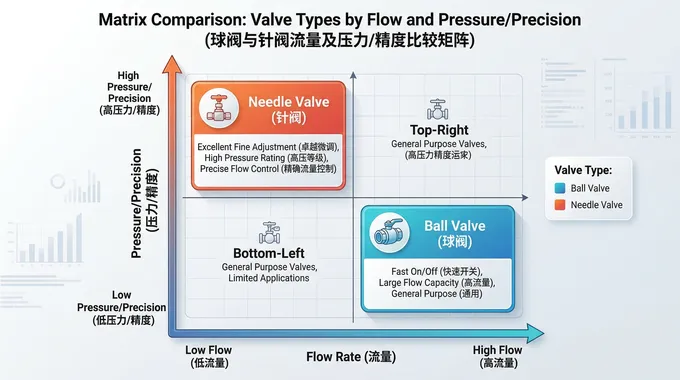
In summary, the choice between a ferrule ball valve and a ferrule needle valve boils down to a fundamental question of system requirements: Do you need speed and capacity, or do you need precision and control? By understanding these distinct operational philosophies, structural differences, and specialized applications, engineers and technicians can design safer, more efficient, and highly optimized fluid control systems. Choose wisely, install correctly, and your pipeline will operate flawlessly for years to come.
 |