Measuring instruments are the core components of industrial automation systems. Their selection directly impacts process control accuracy, equipment stability, and production safety. This article provides a comprehensive and practical guide for engineers, detailing the selection principles and technical points of temperature, pressure, flow, and liquid level instruments, based on typical industrial scenarios like white carbon black production and natural gas measurement.
1. Core Selection Principles
Process Conditions Dictate Instrument Type: Temperature, pressure, corrosiveness, viscosity, and toxicity are foundational. For instance, strong corrosive slurries require integrated RTD temperature transmitters with 316Ti thermowells.
Operational Importance Dictates Configuration: Depending on the impact on the process, functions range from indication to control. Closed-loop control requires transmitters with 4-20mA output, while local tank level indication only needs a magnetic flap level gauge.
Balancing Cost and Maintenance: Standardizing models and bulk purchasing reduce costs. Long-term lifecycle costs must be evaluated (e.g., electromagnetic flowmeters have higher initial costs but longer lifespans than vortex flowmeters).
2. Technical Essentials for Four Major Instruments
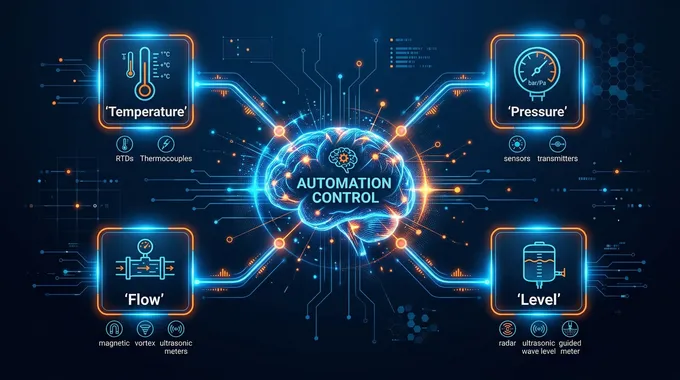
Temperature (精度与响应平衡): Thermocouples (K/J type) for high temps/fast response; RTDs (Pt100) for mid-low temps. Use 316L protection tubes for corrosive media.
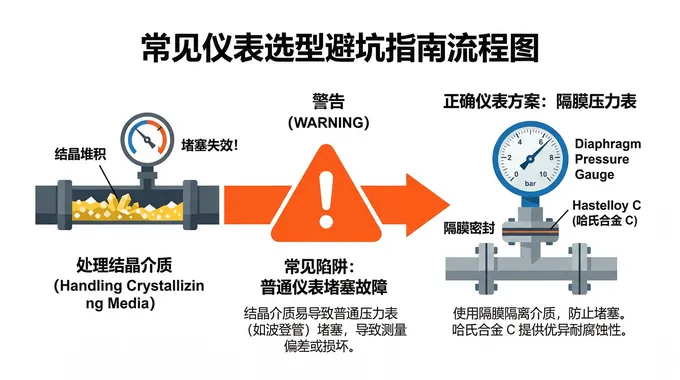
Pressure (安全与可靠保障): Diaphragm pressure gauges for strong corrosives (e.g., Hastelloy C). Use explosion-proof transmitters (IP65+) in hazardous areas.
Flow (介质与原理契合): Electromagnetic flowmeters for conductive fluids (no pressure loss, high accuracy). Vortex or Coriolis mass flowmeters for non-conductive fluids and gases.
Liquid Level (测量方式适配): Radar level transmitters for non-contact continuous measurement. Differential pressure transmitters for interface measurement.
3. Common Pitfalls and Solutions
Ignoring Crystallization: Leads to blockages. Solution: Use diaphragm pressure gauges with extended insertion flanges.
Electromagnetic Interference: Distorts signals (e.g., ±10% fluctuation near inverters). Solution: Install shielded cables and ensure grounding resistance is below 4Ω.
Over-specifying Accuracy: Increases costs unnecessarily (e.g., using 0.1-level radar for a ±5mm need). Solution: Re-evaluate process needs and opt for fit-for-purpose instruments, reducing costs by up to 60%.
4. Future Trends: Smart & Networked Integration
Driven by Industry 4.0, instruments are evolving towards intelligence and networking. Smart transmitters feature self-diagnostics, while wireless HART (LoRaWAN) reduces wiring costs. Edge-computing capabilities will further upgrade systems from mere 'data collection' to 'decision execution'.
The selection of measuring instruments is a multifaceted decision-making process intertwining process requirements, equipment specifications, control strategies, and economic viability. Engineers must cultivate a profound understanding of process demands, master the technical nuances of various instruments, and accumulate practical experience to achieve the ultimate goal of safe, reliable, economical, and efficient selection. As emerging technologies continue to unfold, staying attuned to the trends of instrument intelligence and networking will provide robust support for enterprise digital transformation.