In the complex and intricate world of industrial engineering, pipelines serve as the vital arteries of any facility. Whether they are transporting benign substances like water and air, or hazardous materials like sulfuric acid and chlorine gas, the safe and efficient operation of a plant depends entirely on these networks. However, to the untrained eye, the labyrinth of pipes can appear as a chaotic jumble of metal and plastic. Understanding the markings on industrial pipelines is not merely a matter of technical proficiency; it is a fundamental requirement for workplace safety, maintenance efficiency, and regulatory compliance. In this comprehensive guide, we will delve deep into the critical symbols—DN, Φ, and D—that define pipe dimensions, and we will decode the standardized color schemes used to identify the substances flowing within them.

The Language of Pipes: DN, Φ, and D
When discussing pipeline specifications, precise communication is paramount. A misunderstanding of a pipe's dimensions can lead to disastrous leaks, system failures, or costly rework. The symbols DN, Φ, and D are frequently encountered in engineering blueprints, material take-offs, and on the pipes themselves. Let us explore what each of these signifies.
DN, an abbreviation for Diamètre Nominal (French for Nominal Diameter), is perhaps the most common sizing designation you will encounter in international and European standards (such as ISO and DIN), as well as in Chinese national standards (GB). The DN value is a dimensionless number used as a standardized reference for pipe sizing. It is crucial to understand that DN does not represent the exact inner diameter (ID) nor the exact outer diameter (OD) of the pipe. Instead, it is an agreed-upon, artificial standard diameter that allows pipes, valves, flanges, and fittings to be matched correctly. For example, a pipe designated as DN50 does not mean the pipe has an inner or outer diameter of exactly 50 millimeters. Depending on the pipe's material and wall thickness schedule, the actual inner diameter might be 53 mm, 49 mm, or another nearby value, while the outer diameter remains constant for that specific standard to ensure compatibility with standard fittings.
The Greek letter Φ (Phi) is universally recognized in engineering drawing as the symbol for diameter. In the context of industrial piping, Φ is used to specify the exact physical outer diameter of a pipe or tube. Unlike DN, which is a reference number, Φ is an absolute measurement, usually expressed in millimeters. However, knowing just the outer diameter is insufficient to determine the pipe's capacity or pressure rating. Therefore, when Φ is used, it is almost always accompanied by the pipe's wall thickness. The standard format is Φ Outer Diameter × Wall Thickness. For instance, a specification of Φ25×3 indicates an exact outer diameter of 25 mm and a wall thickness of 3 mm. (From this, one can easily calculate the exact inner diameter: 25 - (3 × 2) = 19 mm).
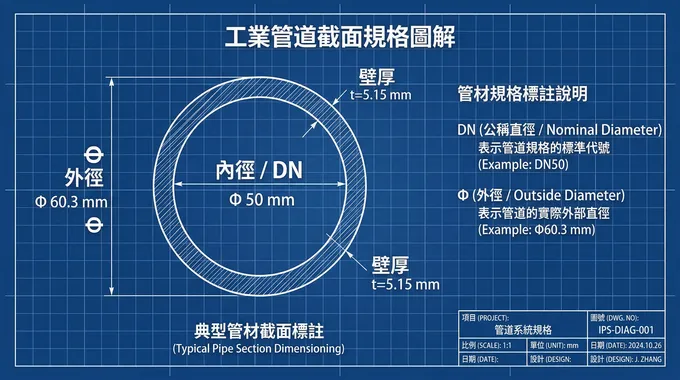
The letter D is a general designator for diameter. Its interpretation requires careful attention to the context in which it is used. Depending on the engineering standard, the specific technical document, or the subscripts attached to it, "D" can mean OD (Outside Diameter), ID (Inside Diameter), or Nominal Diameter in some older or specific regional texts. Because of its ambiguity, "D" should never be assumed. When reading technical documentation, always look for a legend or standard reference that clarifies whether "D" refers to the internal flow path (ID) or the external footprint (OD) of the pipe.
In summary: DN is a reference for compatibility, Φ is an exact measurement of the outer boundary, and D requires context to determine if it means outer, inner, or nominal diameter.
Safety First: The Industrial Pipe Color Code
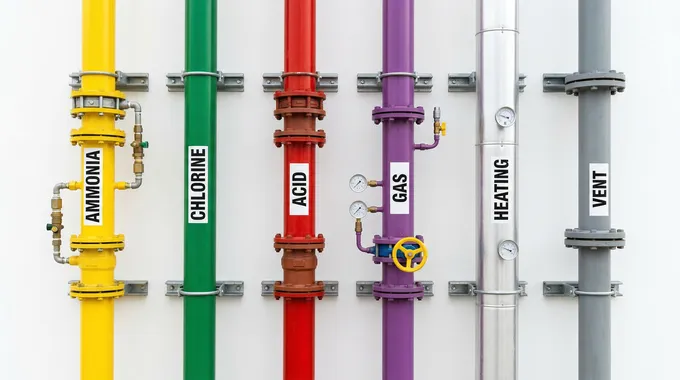
While symbols like DN and Φ tell an engineer how to build or repair a pipeline system, color codes tell operators and safety personnel exactly what is inside those pipes. In an industrial environment, a split-second identification of a pipe's contents can mean the difference between a routine maintenance check and a catastrophic accident. Industrial pipe color coding is not arbitrary; it is governed by strict industry standards (such as ASME A13.1 in the United States or GB 7231 in China) to ensure that hazardous materials, fire-quenching fluids, and safe materials are instantly recognizable.
| Substance | Color Code | Hazard/Reasoning |
|---|---|---|
Ammonia Gas / Liquid Ammonia | Yellow background with Black text | Highly irritating, corrosive, and toxic. Universal warning color. |
Chlorine Gas | Grass Green background with White text | Acutely toxic if inhaled. Alerts to severe respiratory hazard. |
Sulfuric Acid | Red background with White text | Extreme danger and fire risks. Requires full PPE. |
Coal Gas / Syngas | Purple background with White text | Highly explosive fuels. Separates from standard lines. |
Heating Pipes (Steam/Hot Water) | Silver paint (usually unlettered) | Highly reflective for thermal retention. Low toxicity. |
Ventilation Systems (Ductwork) | Grey (excluding plastic ducts) | Neutral color indicating safe, ambient-pressure system. |
Best Practices for Implementation
Implementing these standards across a sprawling industrial complex is a monumental task that requires meticulous planning and ongoing maintenance. The first step in any robust implementation strategy is a comprehensive audit of all existing piping systems. Engineers and safety officers must painstakingly document every pipeline, identifying its contents, pressure, temperature, and current labeling status. This inventory forms the baseline for compliance. Once the baseline is established, a clear, facility-wide policy must be drafted, aligning strictly with relevant national or international standards. This policy should mandate not only the color coding but also the placement of directional arrows and legible text identifying the specific substance and its potential hazards. Furthermore, training is paramount. Every employee, from operators to maintenance staff and contractors, must be thoroughly trained to recognize and understand these visual cues. This knowledge is their first line of defense in an emergency. Regular inspections should be scheduled to ensure that labels remain intact, legible, and uncorrupted by environmental factors such as UV degradation, chemical spills, or physical wear and tear. Any missing or damaged labels must be replaced immediately. By institutionalizing these practices, facilities transform a chaotic maze of pipes into a clearly articulated, safe, and efficient operational environment, safeguarding both human life and critical infrastructure.
Safety is a continuous commitment: Read the signs, respect the standards, and protect the environment.