In the complex and high-stakes world of industrial engineering, a dangerous misconception persists: the direct substitution of a PN16 rated component for a Class 150 component. This "close enough" mindset is a treacherous trap, often serving as the breeding ground for catastrophic pipeline leaks, system failures, and severe safety incidents. Engineering is a discipline of precision, not approximation. |
The Origins: The Mystery of Two Major Systems
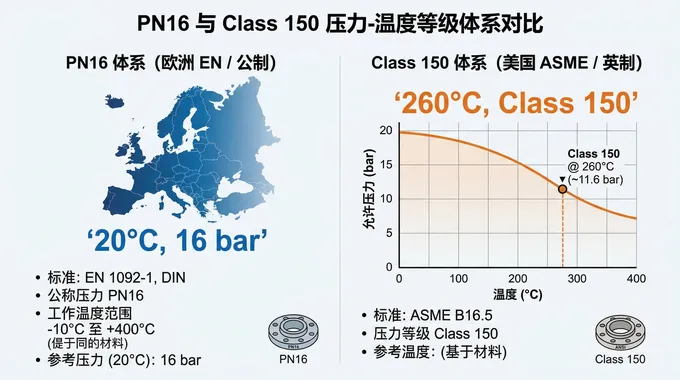
The PN System (The European Standard): Ambient Temperature as the Benchmark The PN system, widely adopted across Europe and heavily integrated into ISO and EN standards, stands for "Pressure Nominal." Its fundamental philosophy is anchored in ambient temperature. The PN number directly represents the maximum allowable working pressure at a specific reference baseline—typically 20°C (68°F), measured in bar. A PN16 fitting carries a literal meaning: at 20°C, the absolute maximum allowable working pressure is exactly 16 bar (1.6 MPa). As temperature rises, allowable pressure drops according to material degradation curves. The Class System (The American Standard): The Temperature-Stress Nexus Conversely, the Class system, rooted in American engineering traditions (ASME/ANSI), does not revolve around a simple room-temperature baseline. It is built upon a complex temperature-stress core, evaluating material allowable stress at specific elevated temperatures, traditionally measured in psi. For Class 150, the historical baseline temperature was set at a scorching 500°F (approx. 260°C) for carbon steel. "150" means it was designed to withstand 150 psi at 500°F; at room temperature, its pressure containment capability is vastly higher. |
 |
Why PN16 ≠ Class150?
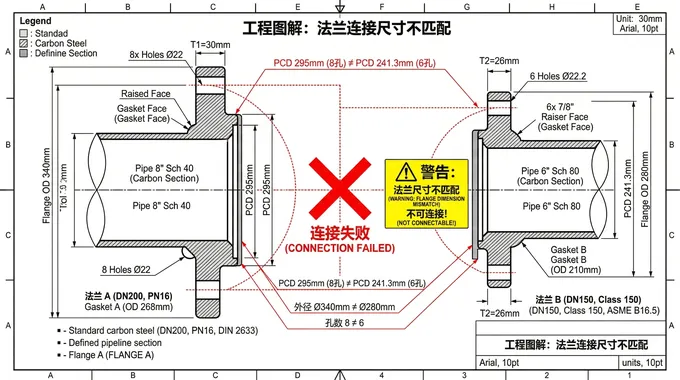
Conclusion first: They are absolutely NOT equivalent, and they CANNOT be directly interchanged under any circumstances. The differences are physical, structural, and metallurgical. Attempting an interchange inevitably leads to compromised structural integrity. The discrepancies manifest across three critical dimensions: 1. The "Temperature Gap Trap" and Pressure Misalignment Because the two systems use fundamentally different baseline temperatures, their actual pressure capacities are misaligned. A Class 150 carbon steel flange's ambient temperature (20°C) allowable working pressure is around 285 psi (approx. 19.6 bar). In stark contrast, a PN16 flange is strictly capped at 16 bar at 20°C. If a PN16 component replaces a Class 150 one, it faces an overpressure condition of nearly 22.5%, creating an immediate rupture hazard. 2. "Dimensional Incompatibility" - Flange Size and Structural Clashes PN16 and Class 150 belong to entirely different dimensional ecosystems. Outside Diameter (OD), Flange Thickness, Pitch Circle Diameter (PCD), the number of bolt holes, hole diameters, and Facing Types (RF or FF) will not match. You physically cannot bolt them together properly. Forcing an assembly will result in uneven gasket compression, leading to immediate leaks or blowouts. |
 |
3. The Dynamic Weighting of Material Properties Standardization bodies utilize different safety margins and yield strength reduction factors. The pressure reduction coefficient of materials across temperature gradients varies significantly between EN and ASME standards, even for the exact same grade of steel. You cannot use a Class system P-T chart to justify the operational safety of a PN system flange at elevated temperatures. |
Approximate Equivalency at Ambient Temperature
If we isolate our focus strictly to ambient temperature (20°C) pressure containment capabilities, Class 150 (approx. 19.6 bar) is actually much closer to PN20 (designed for 20 bar at ambient), rather than PN16. However, this approximation can only be used as a reference during preliminary discussions, absolutely NEVER as a justification for procurement or installation, as physical dimensions will still not match. |
In the realm of piping design and fluid control, there is zero room for guesswork. Pressure is no trivial matter, and component selection requires the utmost rigor. Adhere strictly to P-T ratings and ensure complete system matching: ASME standards require Class-rated flanges; EN/DIN standards require PN-rated flanges. Abandoning the illusion of "almost the same" is the only true pathway to engineering safety. |
 |