Abstract: Many believe that 316L is simply a "more rust-resistant" version of 304, or naively assume "more expensive means better." However, without understanding their fundamental differences in microstructure, weldability, magnetic variation, and high-temperature creep, you might pay a heavy price in engineering material selection or fall for a "consumer trap" in daily products. This article will thoroughly dismantle the hidden war between these two kings of stainless steel, from microscopic composition to macroscopic applications.
Prologue: The Invisible "War of Elements"
In every corner of modern industry and daily life, stainless steel is the silent guardian. Whether you are holding a thermos, walking into an operating room, or standing by the guardrail of a cross-sea bridge, you are in close contact with them.
If the stainless steel industry has a "pop star," it must be 304; and if there is a "strength-based aristocrat," it is undoubtedly 316L.
"There is a common perception in the market: 316L is an upgraded version of 304, more corrosion-resistant, but also more expensive. This is not wrong, but it is only 30% correct. As a rigorous engineer or a savvy consumer, you need to know the remaining 70%."
Why does 316L require no heat treatment after welding, while 304 might decay near the weld seam? Why can some 304 be attracted by a magnet, while 316L remains completely non-magnetic? What exactly does the mysterious "L" represent, and why can it determine the life and death of the material? Today, we will peel back the cold exterior of metal and conduct an ultimate showdown between 304 and 316L from the atomic level outwards, through five dimensions: composition, mechanics, processing, application, and cost.
Chapter 1: The Secret of Alchemy – Composition and Microstructure
All performance differences stem from that one scoop of additives in the melting furnace. Although they both belong to the austenitic stainless steel family, their genetics determine their destiny.
1.1 Molybdenum (Mo): The Expensive "Magic Powder"
The most intuitive difference between 304 and 316L lies in a rare metal—Molybdenum (Mo).
The Formula of 304: The classic 18/8 stainless steel. About 18% Chromium (Cr) is responsible for forming an oxide film on the surface to prevent rust, and 8% Nickel (Ni) stabilizes the austenitic structure. It contains no Molybdenum.
The Formula of 316L: Building upon 304, the Nickel content is increased to 10-14%, and crucially, 2-3% Molybdenum is forcibly added.
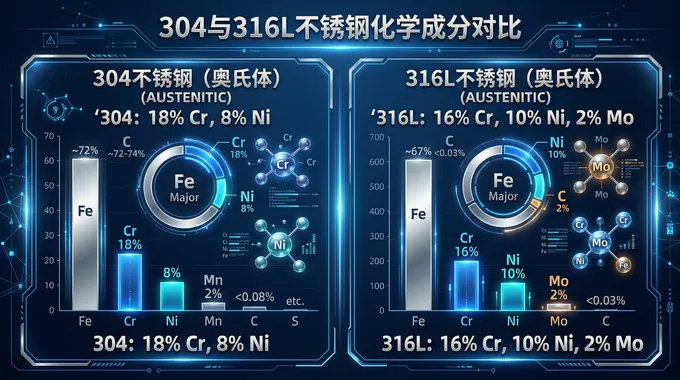
Why is this tiny bit of Molybdenum so important? You can imagine the oxide film of 304 as a standard "bulletproof vest" that can block the "bullets" of water and oxygen. However, when facing "armor-piercing projectiles" like chloride ions (e.g., seawater, brine, bleach), the defense line of 304 is easily penetrated, leading to Pitting Corrosion. The addition of Molybdenum is equivalent to adding a dense energy shield to this bulletproof vest, significantly enhancing its resistance to chlorides.
1.2 The Mysterious Suffix "L": The Lifeline of Carbon
Many overlook the "L" following 316. It stands for Low Carbon.
Carbon content of 304: ≤ 0.08%.
Carbon content of 316L: ≤ 0.03%.
Do not underestimate this 0.05% difference. In metallurgy, carbon is a double-edged sword. Excessive carbon becomes restless at high temperatures (like during welding) and combines with chromium to form chromium carbide. This depletes the chromium at the grain boundaries, creating a "chromium-depleted zone." Once depleted of chromium, the stainless steel is no longer "stainless." This phenomenon is called Intergranular Corrosion. Through its ultra-low carbon design, 316L cuts off the conditions for chromium carbide formation at the root. Therefore, "L" not only means low carbon but also represents superior welding safety.
Chapter 2: Mechanical Properties – A Head-to-Head Clash
If corrosion resistance is defense, then mechanical properties are combat power. Here, things get interesting: 316L is not always the "stronger" one.
2.1 The Game of Strength and Plasticity
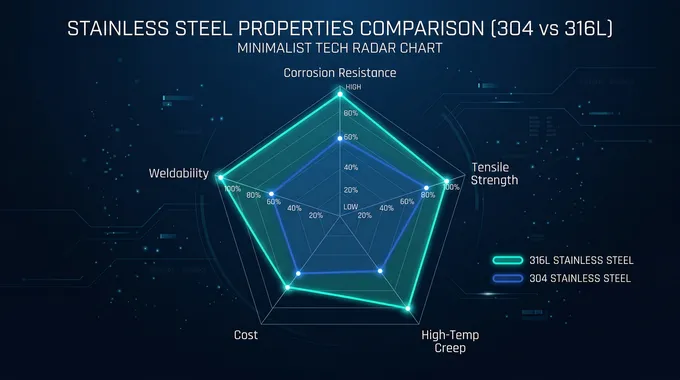
According to material science data, you read that right: the basic strength of standard 304 is actually slightly higher than that of 316L. This is because 316L lowers its carbon content to achieve better corrosion resistance and weldability, which sacrifices some strength (carbon is a potent strengthening element). Therefore, in ordinary bracket or beam designs that do not have high corrosion resistance requirements but demand rigid structural strength, 304 is actually a more cost-effective and sturdy choice.
2.2 The "Endurance Race" at High Temperatures
However, once in the high-temperature domain, the situation instantly reverses. In high-temperature environments, metals slowly undergo plastic deformation like taffy, a phenomenon known as Creep. Because Molybdenum not only resists corrosion but also provides solid solution strengthening, the high-temperature strength and creep resistance of 316L are significantly superior to 304.
Chapter 3: Processing and Welding – An Engineer's Nightmare or Blessing?
For the master craftsmen in manufacturing plants, the "feel" of these two materials is completely different.
3.1 Welding: The Elegance of No Annealing Required
This is the greatest hidden advantage of 316L. When welding 304 stainless steel (especially thick plates), the heat-affected zone near the weld seam is prone to the "sensitization" reaction mentioned earlier. To restore corrosion resistance, solution annealing is usually required after welding—reheating the workpiece to over 1000°C and then cooling it rapidly.
In contrast, because 316L is ultra-low carbon (L), it does not require annealing after welding and still maintains exceptionally strong resistance to intergranular corrosion. For large chemical equipment and on-site piping, 316L is the ultimate savior.
3.2 The Magnetic Myth: Can a Magnet Identify It?
Myth-busting time: "If a magnet doesn't stick, it's good stainless steel; if it does, it's a fake." — This is the biggest misconception.
304: Belongs to "metastable" austenite and is very prone to developing magnetism after cold working. The bent corners of your stainless steel sink can often attract a magnet.
316L: Due to its higher Nickel content, the austenitic structure is highly stable. Even after severe cold working, its magnetic increase is very weak.
Therefore, if a complex stamped part has absolutely no magnetism, it is more likely 316L; but if it has slight magnetism, it is highly likely 304—this does not mean it is a counterfeit.
Chapter 4: Application Scenarios – Who is the Real King?
Based on the chemical and physical properties above, the two have clearly defined territories in the real world.
4.1 The Home Turf of 304: Land, Home, and Light Industry
304 is the undisputed "jack of all trades." As long as it doesn't contact high-concentration salts and specific acids, it is the king of cost-effectiveness.
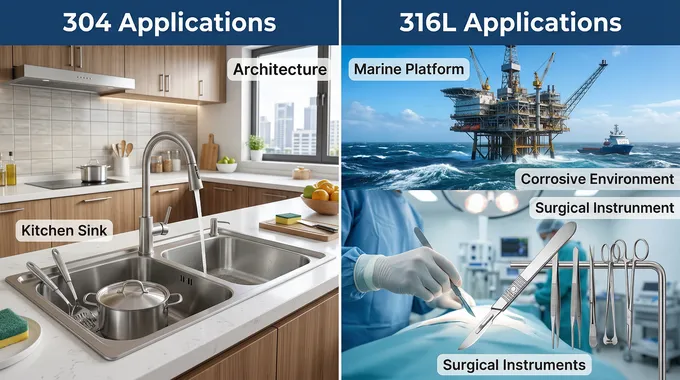
Home Kitchens: Pots and pans, electric kettles, faucets. The salt concentration and contact time at home are not enough to threaten 304.
Dry Environment Construction: Curtain walls, guardrails, and elevator panels in inland cities.
4.2 The Home Turf of 316L: Oceans, Medical, and Extreme Environments
When the environment turns harsh, or requirements become extremely stringent, 304 steps down and 316L takes over.
Marine Engineering: Ship components, offshore oil platforms, railings of seaside villas. The salt carried in the sea breeze is the mortal enemy of 304.
Medical Devices: Orthopedic implants, surgical scalpels, vascular stents. Human body fluids contain salts and have extremely high requirements against metal leaching; 316L possesses better biocompatibility.
Chapter 5: Cost Analysis – Where Did the Money Go?
As of March 2026, the price of 316L stainless steel is typically 50% or more expensive than 304. Where did the money go?
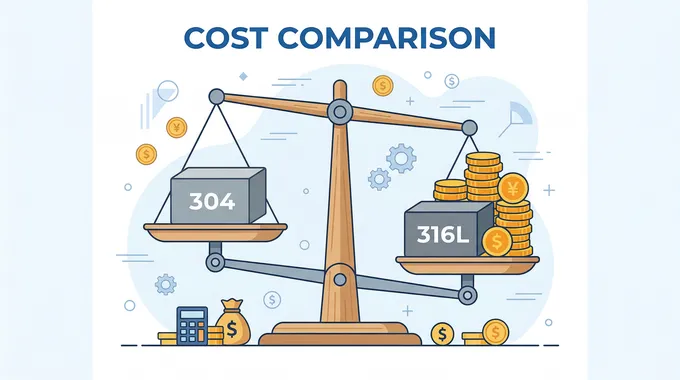
1. Raw Material Premium: Molybdenum is a strategic rare metal, with highly volatile and expensive pricing. The increase in Nickel content (10% vs. 8%) also directly drives up the cost.
2. Smelting Difficulty: Controlling the carbon content below 0.03% requires more advanced refining equipment (such as AOD or VOD furnaces), leading to higher energy consumption and technical thresholds.
Conclusion: How to Choose Wisely?
Returning to the question at the beginning of the article: Does more expensive mean better? The answer is no. Material selection is all about "the right material for the right application."
If you are just buying a pot to boil noodles or installing an indoor stair handrail, choosing 304 is the wisest decision. It is strong enough, easy to process, cheap, and safe. Buying 316L would be pure performance overkill. But if you live by the sea and want to install a security grill, or if you need to manufacture equipment that contacts liquid medicine, you must bite the bullet and upgrade to 316L. The money saved at this moment will turn into tears of rust removal and massive losses from scrapped equipment in the coming years.