Core Components of Stainless Steel Ferrule High-Pressure Ball Valves: Six "Lifebloods" Forging a High-Pressure Legend
On the vast battlefield of industrial pipeline systems, the stainless steel ferrule high-pressure ball valve is hailed as the "pillar of joints" — with a 90° rotation, it cuts off or connects the torrent of high-pressure media. Supporting all this are six core functional components. Each performs its own duty and is indispensable, jointly forging a myth of zero leakage under high-pressure working conditions.
I. Valve Body — Forged Body, Pressure-Bearing Backbone
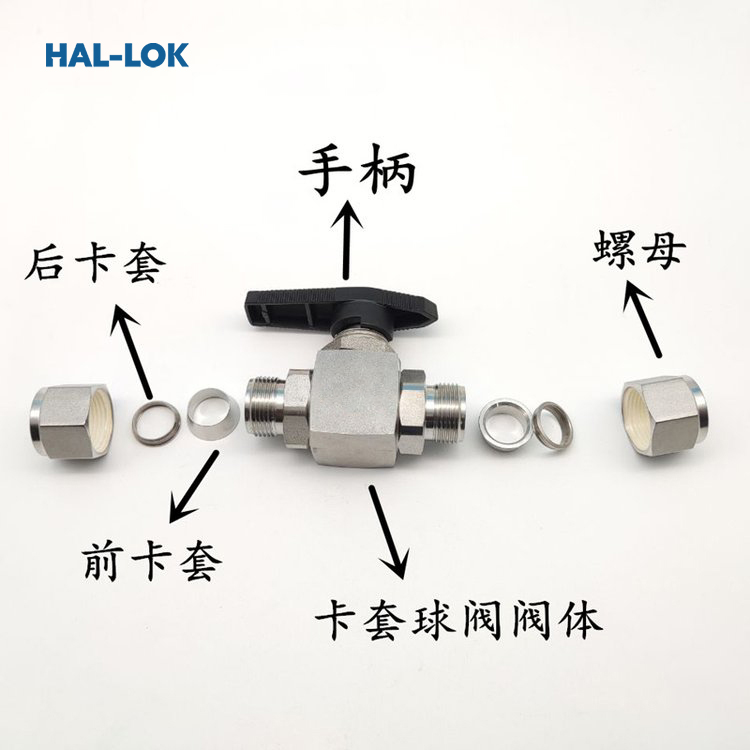
The valve body is the "backbone" of the entire valve. Unlike the casting process of ordinary ball valves, the valve body of a stainless steel ferrule high-pressure ball valve must adopt a high-pressure impact forging process, with a material density far higher than that of castings, and the test pressure can reach up to 150.0MPa. Taking 316L stainless steel as the main material, integrated forging eliminates defects such as porosity, shrinkage, and air holes, ensuring stability like a rock under pressure grades of PN16~PN63 and even higher. Since the valve body material is consistent with the pipeline material, there will be no uneven stress, and it will never deform even when an earthquake or heavy load passes by.
No forged valve body, no qualification for a high-pressure ball valve.
II. Ball — Rotating Heart, Soul of On-Off
The ball is the essential symbol that distinguishes ball valves from all other valves. It is precision-machined from 304/316L stainless steel, with a surface roughness of Ra≤0.4μm, ensuring a smooth flow channel that can even transport slurry media containing solid particles. A through hole is opened on the ball, which rotates 90° with the valve stem — when the hole is aligned with the pipeline, the medium flows unimpeded; when the hole is perpendicular to the pipeline, the channel is completely blocked. During the processing, a computer detector tracks the entire process, with precision that can be described as meticulous.
One rotation of the ball, the pipeline is on or off — this is the entire philosophy of a ball valve.
III. Valve Stem — Force-Transmitting Nerve, Blow-Out Proof Shield
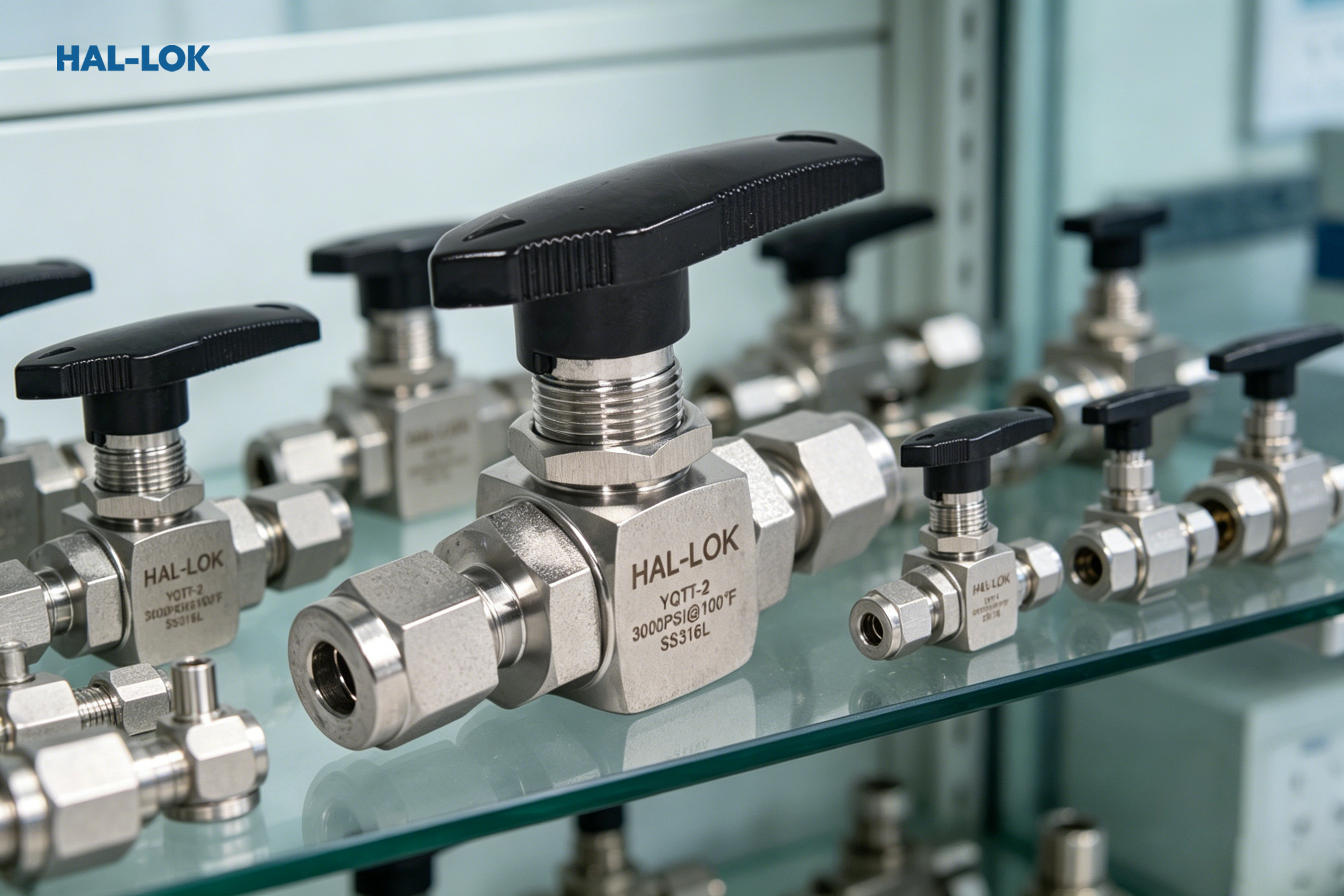
The valve stem connects the handwheel and the ball, serving as the "nerve center" for transmitting torque. The valve stem of the high-pressure ferrule ball valve adopts a bottom-mounted Blow-out Proof structure: when the pressure in the cavity rises abnormally, the valve stem will not be "blown out" by the medium. At the same time, a PTFE thrust washer is installed between the valve stem and the valve body, converting axial force into low-friction rotation, which greatly reduces the operating torque and makes opening and closing light and easy. Some high-end models are also equipped with steel balls and springs to maintain full-valve conductivity for static electricity discharge, achieving both fire and corrosion resistance.
A broken valve stem means the ball valve is scrapped — the blow-out proof design is the safety bottom line for high-pressure working conditions.
IV. Valve Seat — Sealing Lip, Key to Zero Leakage
The valve seat is the most critical component determining the success of sealing. The high-pressure ferrule ball valve is equipped with a spring-loaded pre-tightening valve seat as standard: a disc spring is installed at the tail end of the metal valve seat, continuously pushing the valve seat towards the ball to form a two-way seal. When the sealing surface is worn or burned, the spring automatically compensates to push the valve seat close to the ball, achieving metal sealing. The sealing material can be PTFE soft seal (applicable to -200℃~200℃), carbon fiber reinforced Teflon (temperature and pressure resistant), or hard alloy (temperature resistant up to 600℃+). The higher the pressure, the tighter the seal — this is the ingenuity of the spring pre-tightening structure.
The quality of sealing depends entirely on the valve seat. As long as the spring is intact, the seal will not fail.
V. Valve Cover — Capping Helmet, Pressure Relief Gate
The valve cover closes the upper part of the valve body and compresses the valve stem packing to prevent external leakage. The valve cover of the high-pressure ferrule ball valve has a unique cavity automatic pressure relief function: when the pressure in the valve cavity exceeds the spring pre-tightening force, the valve seat at the outlet end automatically retreats from the ball to discharge abnormal pressure outward, and resets automatically after pressure relief. This design allows the valve to operate safely even under extreme conditions such as fire, which can be called a "life safety valve".
VI. Ferrule Connection Assembly — The Unique "Sixth Lifeblood"
This is the soul that distinguishes ferrule ball valves from all other ball valves! It consists of three parts: 24° conical joint body + sharp inner edge ferrule + compression nut. When the nut is tightened, the ferrule deforms and embeds into the outer wall of the steel pipe to press out an annular groove, and at the same time forms a spherical contact seal with the inner conical surface of the joint body — double protection, no welding required, and the disassembly and assembly efficiency is increased by 80%. The ferrule is made of imported materials (such as German/Korean ferrules) and can be reused multiple times, but it is recommended to replace it compulsorily every 3 disassembly/assembly times or after 5 years of use to avoid leakage caused by stress relaxation.
Ferrule assembly = the "connection heart" of a ferrule ball valve. Without it, it cannot be called a ferrule ball valve!
Conclusion
The six core functional components of the stainless steel ferrule high-pressure ball valve — the forged valve body for pressure bearing, the precision ball for on-off control, the blow-out proof valve stem for force transmission, the spring-loaded pre-tightening valve seat for sealing, the valve cover with cavity pressure relief for protection, and the ferrule assembly for weld-free connection — are interlocking, jointly supporting the safety and reliability under high-pressure working conditions. Precisely because each component has undergone thousands of trials and tribulations, this industrial "joint" can operate 200,000 times without failure, leak-free, and fulfill its mission without compromise in extreme fields such as petroleum, natural gas, semiconductors, and aerospace.