Search for more information

From flat bicycle tires to complex hydrogen fuel cells, containing a gas is an engineering battle against the fundamental laws of physics. Here is why the invisible stuff always wants to break free.
If you fill a plastic bottle with water and screw the cap on tight, you can toss it in your bag without a second thought. The liquid stays put. But if you pump up a bicycle tire and leave it in your garage for a few months, you will likely return to find it flat.
Why the difference? Both systems rely on seals to keep a fluid contained. Yet, across almost every industry—from household refrigeration to industrial compressed-air systems and aerospace engineering—sealing a gas is universally recognized as a much tougher challenge than sealing a liquid.
The answer lies deep within the physics of fluids. Gases naturally escape more easily through microscopic leakage paths, creating demanding and unforgiving sealing conditions. To understand why, we have to look closely at how gases behave when pushed to the limit.
A common misconception is that gas leaks more easily simply because its molecules are smaller than liquid molecules. While this is true for a tiny element like hydrogen, it is not a universal rule. For example, a water molecule (H₂O) is actually smaller than a molecule of nitrogen gas (N₂) or oxygen gas (O₂). Yet, water is vastly easier to seal than air.
If size alone does not explain it, what does? The real culprits are mobility, density, and viscosity.
In a liquid, molecules are packed closely together, bound by intermolecular forces. In a gas, molecules are hyperactive, bouncing around freely with massive amounts of space between them. They act like billions of microscopic pinballs, constantly colliding with the walls of their container, searching for any possible exit.

The most significant factor in sealing is viscosity—a fluid’s resistance to flow. Liquids are relatively "thick." Water, for instance, is about 50 times more viscous than air at room temperature. Oil is even thicker.
To the naked eye, a machined metal flange might look perfectly flat and smooth. But under a microscope, that metal surface looks like a rugged mountain range of peaks and valleys. When two metal surfaces are bolted together, those microscopic valleys create tiny, winding tunnels.
Because liquids have higher viscosity and surface tension, they struggle to navigate these micro-gaps. The liquid essentially gets "stuck," plugging its own leak. Gases, lacking surface tension and possessing incredibly low viscosity, flow through these microscopic scratches with ease. Sealing a liquid is like trying to push honey through a cracked screen door; sealing a gas is like blowing air through it.
Another critical difference is compressibility. You cannot compress a liquid. If you apply pressure to water, its volume remains essentially the same. Gases, however, are highly compressible.
When you compress a gas in a pipeline or a compressor, you are packing those hyperactive molecules tightly together. This acts like winding a mechanical spring—it stores a massive amount of potential energy.
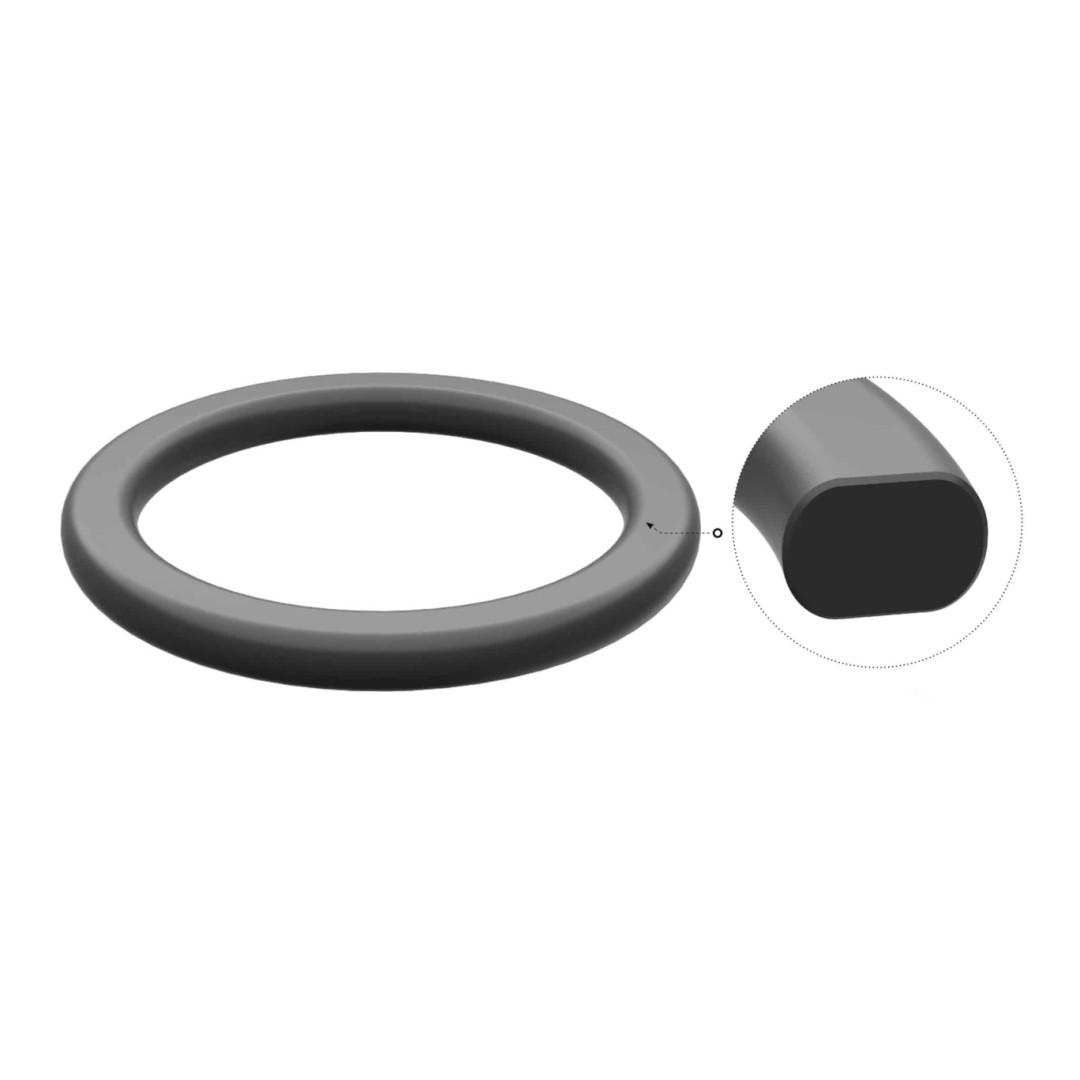
This stored energy wreaks havoc on seals, especially when pressure or temperature changes. In high-pressure gas systems, gas can actually be forced into the microscopic pores of a rubber O-ring. If the system experiences a sudden pressure drop, the trapped gas inside the rubber expands violently. This phenomenon, known as explosive decompression, can literally tear a seal apart from the inside out.
Perhaps the most frustrating trait of gases is that they do not even need a hole to escape. Through a process called permeation, gas molecules can dissolve into and diffuse directly through solid materials.

If you look at the molecular structure of a rubber seal or a plastic hose, it resembles a tangled bowl of spaghetti. Gas molecules can slowly weave their way through these polymer chains and exit on the other side. This is why helium balloons eventually deflate, and why tires lose air over time even if there is no puncture. In advanced applications like hydrogen service, permeation is a nightmare scenario; hydrogen molecules are so small and active that they can even diffuse through solid steel, making long-term containment incredibly difficult.
The difficulty multiplies when moving parts are involved, such as in pumps, valves, and compressors. These require "dynamic seals" that prevent leaks while a shaft is spinning or sliding.
Liquids are generally excellent at self-lubricating and cooling. A liquid pump relies on the fluid itself to reduce friction and carry away heat from the mechanical seal. Gases provide almost zero lubrication and very little cooling. If a dynamic gas seal runs dry, the friction generates immense heat, causing the seal material to degrade, warp, or melt in a matter of seconds.
Finally, there is the issue of detection. When a water pipe or an oil valve leaks, the evidence is obvious: a puddle, a stain, or a drop in pressure.
Gas leaks, on the other hand, are often invisible, odorless, and silent. A compressed-air system in a factory can leak thousands of dollars' worth of energy a year without anyone noticing. Refrigeration equipment can slowly bleed its freon into the atmosphere, only revealing the leak when the fridge finally fails to keep food cold.
Because gas is so desperate to escape, engineers have developed sophisticated methods to keep it contained:
Superior Surface Finishes: Metal surfaces in gas systems are machined and polished to near-mirror finishes to eliminate the microscopic "mountain ranges" where gas can slip through. Advanced Elastomers: Engineers carefully select specific O-ring materials (like Viton or Nitrile) with low permeability and apply exact compression ratios to ensure the rubber fills every microscopic void. Multi-Stage and Labyrinth Seals: In fast-moving turbines and compressors, engineers use labyrinth seals—a series of complex, winding barriers that force the gas through a tortuous path, dropping its pressure stage by stage until it can no longer push through. Barrier Fluids: Sometimes, the best way to seal a gas is with a liquid. In many mechanical seals, a pressurized liquid or "purge gas" is injected between two seal faces to create an impenetrable barrier that the process gas cannot cross. Rigorous Testing: Gas systems are often tested using helium "sniffers" or ultrasonic acoustic detectors that can hear the high-frequency hiss of a microscopic leak.
Ultimately, sealing a liquid is a matter of blocking physical holes. Sealing a gas is a matter of managing microscopic chaos. It requires a deep understanding of thermodynamics, material science, and fluid dynamics.
The next time you top off your car tires, open a pressurized valve, or simply grab a cold drink from your refrigerator, take a moment to appreciate the invisible engineering at work. Keeping a liquid in a bottle is easy; keeping an invisible, hyperactive gas exactly where it belongs is a quiet triumph of modern science.