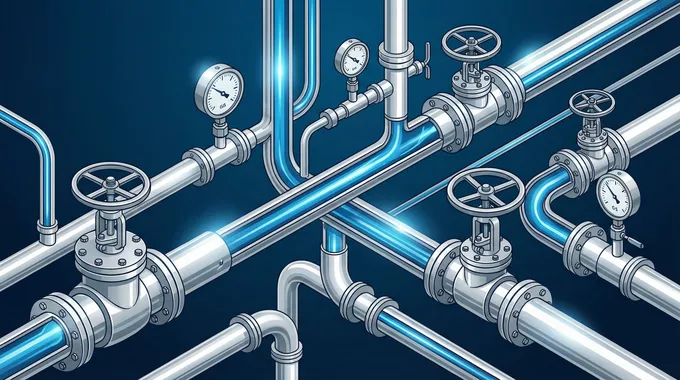
Gas pipelines often remain hidden behind equipment, acting as the "silent movers" of modern industry. From the 9N purity requirements of semiconductor factories to the 70MPa high-pressure challenges of hydrogen refueling stations, connections and sealing are not only the vessels of the process but also the core lifeline of production safety. A single loose screw can lead to millions in losses.
01 Hardcore Breakdown: Top 5 Mainstream Connection Forms
1. Threaded Connection: The Game of Economy vs. Risk
Threaded connections are the most basic form in the industry. Although low in cost, they are increasingly marginalized in high-precision fields. When wrapping PTFE tape on high-purity gas pipes, **2-3 threads must be left exposed at the port**, preventing debris from falling into the pipe and causing particulate pollution.
⚠️ Restricted Area Warning:Hydrogen pipelines are explicitly prohibited from using threaded connections. Since hydrogen molecules are extremely small and flammable/explosive, the risk of micro-leakage in thread gaps is unacceptable. |
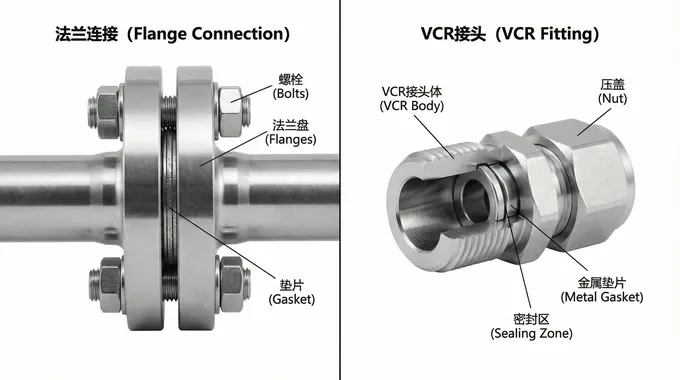
2. Flange Connection: The Heavyweight of Modular Design
Flanges are the mainstay of detachable connections. Modern high-purity systems have eliminated asbestos gaskets in favor of soft metals (silver, copper) or PTFE gaskets. The key to sealing lies in preload management.
Accident Case:A semiconductor factory once suffered a severe helium leak. Investigation revealed it was due to flange bolt torque deviation, leading to local stress concentration and uneven gasket force, causing over a million in annual losses. |
3. Welded Connection: Pursuing Atomic-Level Permanent Sealing
When safety requirements reach the extreme, welding is the only choice. High-purity gas standardizes on automatic orbital argon arc welding. Beware of "Dead Space"; socket welding tends to accumulate impurities, while optimized butt welding can control dead space to within 5mm.
Accident Case:During copper pipe welding in a lab, nitrogen protection was interrupted, causing high-temperature oxidation and blackening of the weld joint, leading to a copper ion contamination event. |
4. Compression Fitting: The "Lego" of Precision Instruments
Double ferrule designs separate sealing and gripping functions, reducing leakage rates by 2 orders of magnitude. Ferrule hardness must be HRC≥45 to ensure effective "biting". However, fittings fear vibration the most; long-term micro-vibrations can lead to nut loosening.
5. VCR Connection: The Ultimate Defense in the Semiconductor Industry
If threads are "economy housing", VCR is a "luxury mansion". It achieves zero leakage by compressing high-purity nickel gaskets and is standard for Ultra High Purity (UHP) and toxic gases.
Operational Taboo:Installation must use a dedicated torque wrench. Overtightening causes the silver plating on the sealing surface to peel off; a chip factory reduced the life of expensive fittings by 60% due to this. |
02 Technological Evolution: From "Stopping Leaks" to "Smart Sensing"
Metal Seal Limit Breakthrough: Delta seal ring technology uses metal elasto-plastic deformation to achieve over 10 years of zero leakage at 600°C and 25MPa.
Disruptive Advantage of Flexible Materials: ePTFE (expanded PTFE) creates a microporous structure through bidirectional stretching, reducing gas permeability to 1/10 of traditional PTFE.
IoT Monitoring: Embedding micro pressure sensors in VCR fittings to analyze sealing status in real-time can reduce unplanned downtime by 75%.
03 Real-World Scenarios: Gold Standards in Three Major Fields
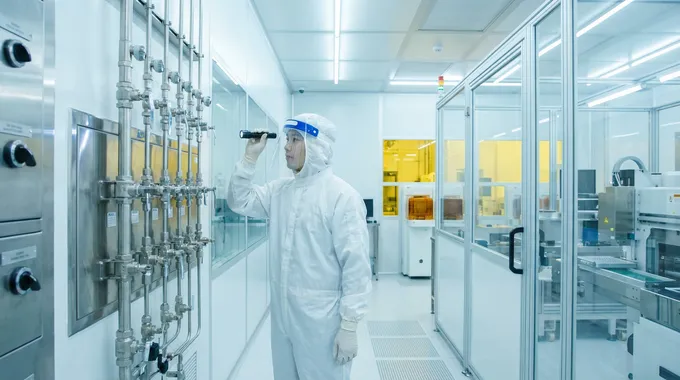
A. Semiconductor Special Gas Delivery: Purity is Life
Scheme: VCR fittings + Automatic argon arc welded pipes + 316L stainless steel.
Plasma cleaning must be performed before installation to remove surface oxide layers. A 12-inch wafer fab achieved a toxic silane leakage rate as low as 1×10⁻⁹ through extreme craftsmanship.
B. Medical Gas Systems: Biocompatibility is the Bottom Line
Scheme: 316L compression fittings + Diaphragm valves.
All seals must pass USP Class VI biocompatibility certification to prevent precipitates from causing patient infection, strictly enforcing NFPA 99 pressure tests.
C. Hydrogen Infrastructure: Fighting "Hydrogen Embrittlement" & High Pressure
Scheme: Double ferrule fittings + Cone & Thread composite structure.
Hydrogen-compatible sealing materials (like HNBR) must be used to prevent hydrogen molecule permeation and metal embrittlement.
04 Conclusion
The connection and sealing of gas pipelines may seem like simple mechanical assembly, but it is actually a comprehensive game of materials science, mechanics, and precision machining. For engineers, understanding the principles and limitations behind each connection form and strictly following installation specifications is not only responsible for engineering quality but also a reverence for life. Do not let a loose nut become the Achilles' heel of the system.