The Ultimate Guide to Stainless Steel Compression Straight Needle Valves: Installation, Features, and Maintenance
Introduction: The Unsung Heroes of Industrial Precision
In the complex arteries of modern industrial piping systems, precision flow control is not merely a requirement—it is the bedrock of operational safety, process efficiency, and ultimate product quality. Among the myriad of valve technologies available today, the stainless steel compression straight needle valve has emerged as the gold standard for applications demanding pinpoint throttling and uncompromising shut-off capabilities in the most unforgiving environments.
Characterized by its exceptional corrosion resistance, space-saving compact design, and unparalleled mechanical robustness, this valve has become an indispensable asset across vital sectors—from oil and gas and petrochemicals to nuclear power generation, biopharmaceuticals, and food processing.
This comprehensive, in-depth guide is designed to dissect the stainless steel compression straight needle valve from every angle. We will explore its fundamental working mechanics, detail the standardized installation protocols, highlight its core technological advantages, and provide actionable best practices for lifecycle maintenance. Whether you are a plant engineer specifying components for a multi-million-dollar project, a maintenance technician on the front lines, or a project manager optimizing lifecycle costs, this article serves as your definitive technical reference.
1. Standardized Installation: From Pipe Preparation to Ultimate Seal Verification
The long-term performance and leak-free reliability of compression needle valves hinge entirely on proper installation. Even the most highly engineered valve will fail prematurely if basic installation protocols are ignored. A systematic, step-by-step approach is mandatory.
01Rigorous Pipe Preparation
The foundation of a perfect seal begins long before the valve is attached. Careful preparation of the piping is non-negotiable:
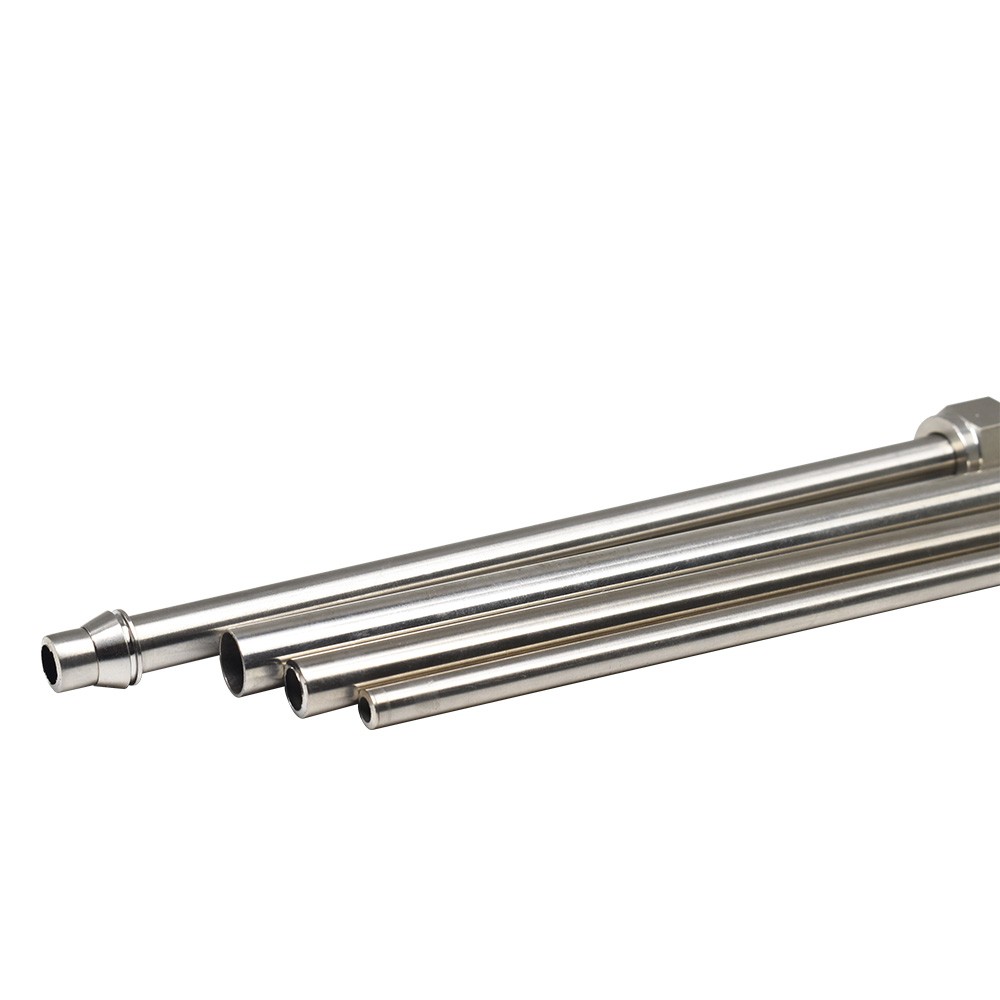
Precision Cutting Requirements: Utilize a professional-grade tube cutter or specialized saw to guarantee the tube end is cut square. The perpendicularity error must not exceed 0.5 degrees. All burrs, both internal and external, must be meticulously removed with a deburring tool. Case in point: In a refinery's catalytic cracking unit, a tube end inclination of just 0.6 degrees caused uneven embedding of the ferrule, resulting in a microscopic leak that led to thousands of dollars in unscheduled downtime. Ensure the tube remains perfectly straight for a minimum distance of three times the nut length from the end.
Stringent Cleaning Standards: The tube surface and interior must be completely devoid of oil, grease, dirt, and metal shavings. For high-purity applications (such as semiconductor manufacturing), ultrasonic cleaning followed by high-pressure nitrogen purging is required to meet ISO 14644-1 Class 5 cleanliness standards. Foreign debris will score the ferrule seating surfaces and compromise the seal.
Bending Considerations: When routing requires tube bending, the straight section from the end of the tube to the genesis of the bend must be at least three times the length of the compression nut. This prevents ovality and stress concentration, allowing the ferrule to grip a perfectly round surface.
02The Art of Ferrule Assembly
The orientation and seating of the compression fittings dictate the mechanical integrity of the joint:
Directional Confirmation: Slide the nut, followed by the back ferrule, and finally the front ferrule onto the tube. Crucial Rule: The cutting edges of both ferrules must face toward the fitting body. An offshore platform once incurred 6 million RMB in annual maintenance costs due to a systemic error where technicians installed ferrules backwards.
Strategic Lubrication: Apply a microscopic film of premium anti-seize lubricant (preferably containing molybdenum disulfide) to the threads of the fitting body and the outer surfaces of the ferrules. This mitigates friction, ensures consistent torque application, and prevents the dreaded galling of stainless steel threads.
Pre-installation Positioning: Insert the tube into the fitting body until it bottoms out firmly against the internal shoulder. Maintain this axial pressure while hand-tightening the nut until it contacts the back ferrule. Verify that the tube is perfectly coaxial with the valve body (maximum misalignment of 0.2mm).
03Torque Control and Rigorous Seal Verification
Creating a reliable metal-to-metal seal requires precise mechanical force:
The Two-Stage Tightening Process:Warning: Over-tightening causes severe ferrule deformation and can crack the valve body. Under-tightening guarantees a blowout under pressure.
First Stage: Using a calibrated torque wrench, tighten the nut clockwise to approximately 70% of the target torque. (e.g., For a DN15 valve requiring 45 N·m, tighten to 31-32 N·m). You will feel the front ferrule begin its bite into the tube wall.
Second Stage: Continue tightening until a sharp increase in resistance is felt (the pressure point). Rotate the nut an additional 1/4 to 1/2 turn. This drives the back ferrule forward, creating a secondary mechanical grip and providing critical axial support.
Mandatory Seal Testing:
Gas Systems: Employ a helium mass spectrometer leak detector (sensitivity of 1×10⁻⁹ Pa·m³/s) for critical systems.
Liquid Systems: Execute a hydrostatic test at 1.5 times the maximum working pressure, holding for 30 minutes with zero allowable pressure drop.
2. Six Core Advantages of Quality Compression Needle Valves
Why choose a compression needle valve over traditional flanged or threaded alternatives? The engineering advantages are profound.
2.1 Superior Corrosion Resistance
High-end valves utilize duplex stainless steel (e.g., 2205, UNS S31803) boasting a Pitting Resistance Equivalent Number (PREN) ≥ 35. This delivers a 50% leap in chloride corrosion resistance compared to standard 316L, making it the premier choice for offshore and coastal facilities. For pharmaceutical applications, electrolytic polishing achieves a surface roughness of Ra ≤ 0.4μm, completely inhibiting microbial biofilm formation.
2.2 The Triple Sealing Mechanism
Primary Seal: The front ferrule's cutting edge embeds into the tube wall, achieving a metal-to-metal leak rate of < 1×10⁻⁶ mbar·L/s.
Secondary Seal: The back ferrule creates spherical contact with the body's cone, tripling the vibration load capacity compared to single-ferrule designs.
Emergency Seal: Stored elastic deformation in the ferrules provides residual sealing force during thermal cycling or system upsets, preventing catastrophic blowouts.
2.3 Compact and Modular Design
Modern DN10 valves measure just 120mm in length, slashing weight by 40% versus flanged equivalents. Furthermore, "valve-instrument integration" allows sensors to be mounted directly into the valve body. A leading chemical plant reported a 30% reduction in total piping joints after adopting this modular approach, drastically reducing potential leak paths.
2.4 Extreme Temperature and Pressure Ratings
Modified 316L material maintains >35% elongation at break even at -196°C (liquid nitrogen). Conversely, optimized ferrule geometry keeps stress concentration factors safely below 1.8 at extreme pressures up to 63MPa.
2.5 Quick Disassembly and Reusability
The entirely weld-free installation eliminates heat-affected zones and fire risks in hazardous areas. Remarkably, the ferrule assembly can be disassembled and reinstalled up to five times. Following ultrasonic cleaning, sealing performance consistently recovers to 95% or better.
2.6 Smart Integration Capabilities (Industry 4.0)
Advanced designs now feature reserved M12 interfaces for IoT condition-monitoring sensors (temperature, pressure, vibration). Coupled with ANSYS digital twin simulations that optimize material distribution, these smart valves have extended typical seal lifespans from 5 to 8 years in field applications.
3. Working Principle: The Synergy of Mechanical Sealing and Flow Control
To master the maintenance of these valves, one must understand their internal physics.
3.1 The Seal Formation Process
Tightening the compression nut triggers a highly choreographed mechanical sequence:
The nut drives the back ferrule, which propels the front ferrule along the 24-degree conical seat of the valve body.
Forced radially inward, the front ferrule's cutting edge embeds 0.1mm to 0.3mm into the stainless steel tube, forging the primary seal.
The back ferrule undergoes a controlled plastic deformation of 3% to 5%. This acts as a mechanical spring, maintaining constant compressive force even as the system undergoes violent thermal expansion and contraction.
3.2 Precision Flow Control Mechanism
Needle-Type Poppet: A 60-degree conical needle mates with a precision seat, allowing microscopic adjustments (0.05mm to 0.5mm). This yields a highly linear flow characteristic perfect for analytical throttling.
Fluid Dynamic Optimization: CFD simulations have refined the internal flow path, dropping the flow resistance coefficient (ξ) to ≤ 1.2—a 40% efficiency improvement over traditional globe valves.
Dynamic Stem Sealing: PTFE packing rings compensate for machining tolerances and dynamic wear, ensuring the stem remains perfectly sealed during thousands of actuation cycles.
4. Usage Considerations: Guidelines for Maximum Service Life
4.1 Media Compatibility
Chloride Limits: For standard 316L, process fluid chloride ions must remain below 25ppm to prevent stress corrosion cracking.
Hydrogen Service: Valves handling hydrogen must undergo vacuum dehydrogenation (200°C for 4 hours) to prevent hydrogen embrittlement of the steel matrix.
4.2 Operational Best Practices
Actuation Speed: Always allow a minimum of 5 seconds for a full stroke. Rapid opening/closing triggers water hammer, which physically degrades the sealing surfaces.
Directionality: Installation must strictly align with the flow arrow on the valve body. Reverse flow induces hydraulic forces that will slowly unscrew the compression fitting over time.
4.3 Environmental Adaptation
Vibration Dampening: If ambient vibration exceeds 20Hz (e.g., near heavy compressors), rubber vibration dampers must be installed on adjacent piping to prevent cyclic fatigue of the ferrule bite.
5. Maintenance and Troubleshooting: Systematic Component Restoration
5.1 Common Fault Diagnosis
| Fault Symptom | Root Cause Analysis | Professional Solution |
|---|---|---|
| External Leakage at Fitting | Thermal cycling loosening; Tube wall scoring | Retighten to 90% of original torque. If unresolved, cut tube and install fresh ferrules. |
| Internal Leakage (Pass-through) | Seat scratched by particulates; Worn needle tip | Lap the valve seat. Replace needle component. Install upstream filtration. |
| Stiff Handwheel Operation | Over-torqued packing; Bent stem; Thread galling | Loosen packing gland slightly. Replace stem. Clean and re-lubricate threads. |
5.2 Advanced Repair Techniques
Rather than discarding expensive valves, modern facilities employ advanced restoration:
Plasma Surfacing: Worn valve seats are repaired using plasma spray technology to deposit Stellite 6 alloy, achieving a hardness of HRC 45—often outperforming the original factory spec.
Hard Chrome Plating: Scored valve stems are electroplated with 0.05mm–0.1mm of hard chromium, restoring the dimensional tolerance and drastically enhancing wear resistance.
6. Industrial Applications: Proven Real-World Performance
Petrochemical (Catalytic Cracking)
Operating at 550°C and 8MPa, dual-ferrule valves provide zero-leakage control for critical instrumentation lines, surviving extreme thermal shocks.
Power Generation (Nuclear)
Certified to ASME BPVC Section III, these valves operate in primary coolant systems, maintaining absolute purity with maximum allowable conductivity of 10⁻⁷ S/cm.
Semiconductor Manufacturing
Utilizing specialized PVDF wetted surfaces, these valves guarantee metal ion leaching of less than 0.1ppb, satisfying the ultra-strict SEMI F57 standards for ultra-pure water distribution.
Biopharmaceuticals
316L electropolished valves endure relentless 130°C SIP (Sterilization in Place) cycles while maintaining absolute biological sterility for aseptic filling lines.
Conclusion: Engineering the Future of Flow Control
Stainless steel compression straight needle valves are the vital "precision joints" of global industrial infrastructure. Their unwavering performance dictates the safety, efficiency, and economic viability of modern process plants. By rigorously adhering to standardized installation protocols, implementing proactive digital maintenance schedules, and understanding the deep mechanics of their design, plant operators can drastically reduce their Total Cost of Ownership (TCO).
As we pivot deeper into the era of Industry 4.0, the evolution of these valves continues. The integration of IoT sensors, digital twin predictive modeling, and advanced metallurgy is transforming the humble needle valve into a smart, self-diagnosing node within the industrial network. By mastering the principles outlined in this guide, engineering professionals can ensure their systems remain leak-free, highly efficient, and ready for the demands of tomorrow's industrial landscape.