Compression Tube Fittings: The 'Swiss Army Knife' of Global Small-Diameter Piping Systems
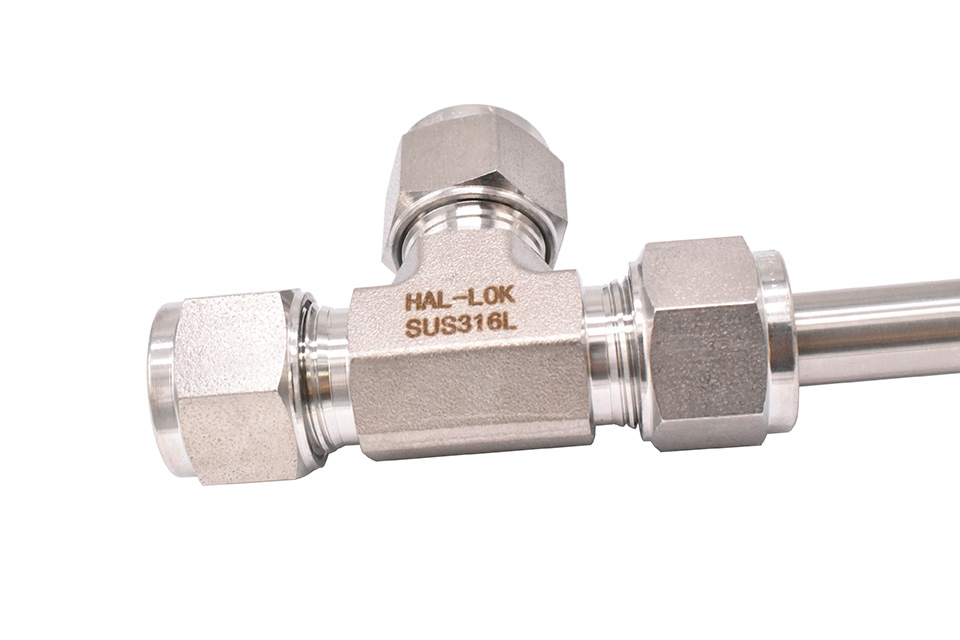
In the labyrinthine world of modern industrial engineering, it is rarely the massive reactors or towering distillation columns that determine the ultimate reliability of a system. More often than not, the true arbiters of safety, efficiency, and operational continuity are the smallest components. Among these unsung heroes, compression tube fittings stand paramount. Widely regarded as the "Swiss Army Knife" of global small-diameter piping systems, these precision-engineered connectors are the vital joints holding together the arteries of modern industry.
From the freezing vacuum of aerospace applications to the ultra-clean environments of semiconductor manufacturing, and from the high-pressure depths of offshore oil rigs to the cutting-edge hydrogen fuel cells powering the green energy transition, compression tube fittings are ubiquitous. This article delves deep into the mechanical genius, material science, and cross-industry versatility of these indispensable components.
1. The Anatomy of Precision: Understanding the Mechanics
To appreciate why compression tube fittings are universally adopted, one must first understand the elegant engineering that underpins their function. Unlike traditional threaded or welded connections, compression fittings rely on mechanical deformation to create a hermetic, leak-tight seal.
The Double-Ferrule Design: A Masterclass in Mechanical Engineering
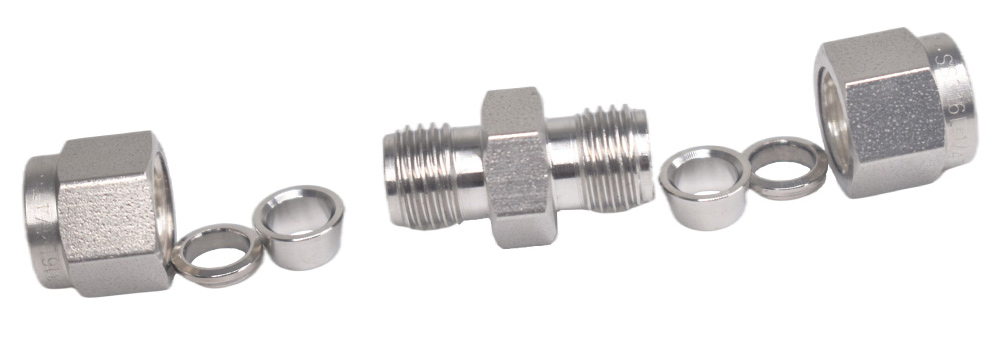
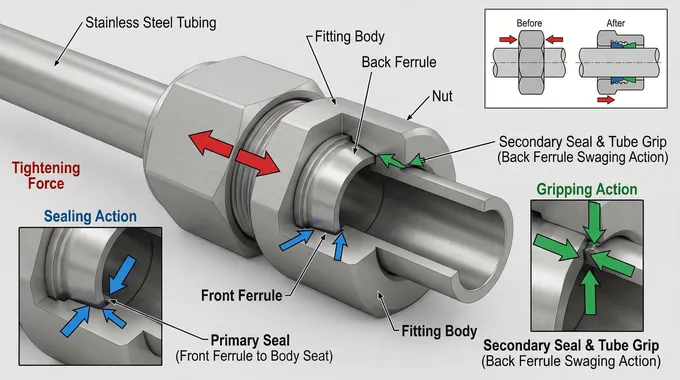
The most advanced and widely utilized variation is the double-ferrule compression fitting. This system consists of four precision-machined components: the nut, the back ferrule, the front ferrule, and the fitting body.
When the nut is tightened, a sequence of highly controlled mechanical actions occurs:
1. The Thrust: The nut drives the back ferrule forward.
2. The Grip: The back ferrule, designed with a specific geometry, pushes against the front ferrule while simultaneously driving its own edge into the tubing. This creates a robust mechanical grip that prevents the tube from blowing out under extreme pressure.
3. The Seal: The front ferrule is forced into the tapered throat of the fitting body. As it compresses, it burnishes against the tube and the fitting body, creating a continuous, metal-to-metal primary seal.
This separation of functions—the back ferrule for gripping and the front ferrule for sealing—ensures that vibrational fatigue, thermal cycling, and pressure spikes do not compromise the integrity of the connection.
Eliminating the Need for Elastomers
Traditional O-rings and elastomeric seals degrade over time, especially when exposed to harsh chemicals, extreme temperatures, or UV radiation. Compression tube fittings bypass this vulnerability entirely through metal-to-metal sealing. By utilizing advanced metallurgical processes, manufacturers ensure that the ferrules are harder than the tubing they grip, allowing for precise plastic deformation without causing catastrophic damage to the pipe's structural integrity.
2. Why They Are the "Swiss Army Knife" of Piping
The moniker "Swiss Army Knife" is not given lightly. It reflects a unique combination of versatility, reliability, and adaptability that no other connection method can match in small-diameter (typically 1/16 inch to 2 inches) fluid systems.
Unmatched Versatility Across Extreme Environments
Industrial fluid systems rarely operate under benign conditions. Engineers must contend with highly corrosive media (such as sour gas or concentrated acids), extreme cryogenic temperatures (like liquid natural gas at -162°C), and blistering heat. Compression fittings are manufactured from a vast array of materials to meet these exact needs. While 316/316L stainless steel is the industry standard, these fittings are also machined from exotic alloys such as Monel, Hastelloy, Inconel, and Titanium. This material flexibility allows engineers to deploy the exact same fitting design across fundamentally different chemical and thermal environments.
Installation Efficiency: The Antidote to Welding
In hazardous environments, such as active petrochemical plants or offshore platforms, welding is often strictly prohibited due to the risk of explosion (requiring expensive and time-consuming "hot work" permits). Compression tube fittings eliminate the need for welding.
Installation requires only standard wrenches and a few simple steps. A trained technician can assemble a leak-tight connection in a matter of minutes. Furthermore, unlike welded joints, compression fittings can be disassembled and reassembled multiple times without losing their sealing capabilities, drastically reducing maintenance downtime and total cost of ownership (TCO).
Immunity to Vibrational Fatigue
In systems involving heavy machinery, compressors, or moving vehicles, vibration is the silent killer of rigid piping systems. The double-ferrule design inherently dampens vibration. The mechanical grip of the back ferrule isolates the sealing point (the front ferrule) from the stress of tube movement. This "spring-like" action ensures that micro-movements do not translate into microscopic leaks, a critical feature for industries where a single leak can result in catastrophic failure.
3. Driving Global Industries Forward
The true impact of compression tube fittings is best understood by examining their role in the critical industries that power the modern world.
Oil & Gas and Petrochemicals: The Frontline of Durability
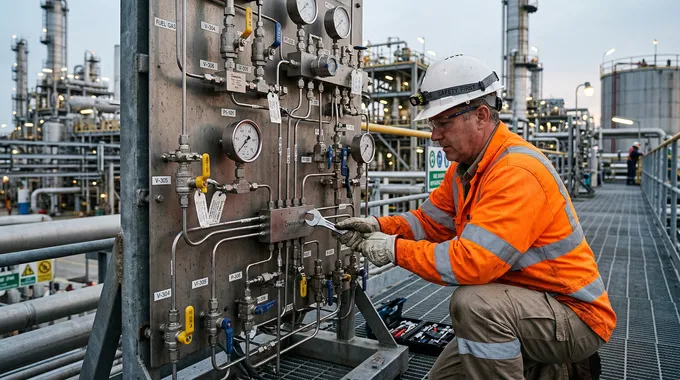
In the upstream oil and gas sector, instrumentation panels control the flow of hydrocarbons at pressures exceeding 10,000 PSI. Here, compression fittings are used in wellhead control panels, chemical injection skids, and hydraulic power units. Their ability to withstand the highly corrosive nature of hydrogen sulfide (H2S) and chloride-rich marine environments makes them non-negotiable components for offshore safety.
Semiconductor and Ultra-High Purity (UHP) Systems
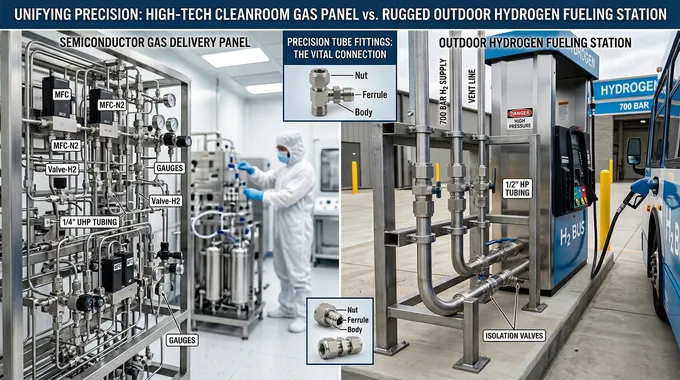
The microchips that power our smartphones, computers, and AI servers are manufactured in cleanrooms where contamination is measured in parts per trillion. The delivery of precursor gases used in chemical vapor deposition (CVD) requires piping systems with zero dead volume and absolute leak tightness. Specialized high-purity compression fittings, often electropolished and assembled in cleanrooms, ensure that no microscopic particulates or moisture infiltrate the gas lines, safeguarding billion-dollar manufacturing yields.
Hydrogen Energy and the Green Transition
As the world pivots toward sustainable energy, hydrogen has emerged as a crucial fuel. However, hydrogen molecules are the smallest in the universe, making them notoriously difficult to contain. They can diffuse through solid steel and exploit the tiniest microscopic flaws in a seal. Furthermore, hydrogen fueling stations operate at staggering pressures (up to 700 bar or 10,000 PSI). Advanced compression tube fittings, specifically designed with optimized ferrule geometries and advanced metallurgy to resist hydrogen embrittlement, are the standard for hydrogen containment, storage, and dispensing systems.
4. Selection and Installation: Best Practices for Engineers
Despite their brilliant design, the reliability of a compression tube fitting is ultimately dependent on proper selection and flawless execution by the end-user.
Matching Materials to the Medium
Galvanic corrosion is a severe risk in fluid systems. Engineers must ensure that the material of the tubing matches the material of the fitting. Mixing a carbon steel tube with a stainless steel fitting in a wet environment will rapidly accelerate corrosion. Furthermore, the hardness of the tubing must be strictly controlled; it must be softer than the fitting's ferrules to allow for proper deformation and grip.
The Art of Proper Installation
The most common cause of fitting failure is not a manufacturing defect, but human error during installation—specifically, under-tightening or over-tightening.
* Under-tightening fails to fully engage the ferrules, leading to immediate leaks or catastrophic tube blow-out under pressure.
* Over-tightening crushes the tubing, restricting internal flow and severely compromising the structural integrity of the metal, leading to premature fatigue failure.
Industry best practices dictate the strict use of gap inspection gauges. These simple, go/no-go tools allow technicians to physically verify that the nut has been tightened the exact required number of turns (typically 1-1/4 turns past finger-tight for standard sizes), entirely removing the guesswork from the installation process.
Conclusion: The Future of Fluid Connections
Compression tube fittings are much more than mere hardware; they are the critical enablers of modern industrial progress. By combining metallurgical science with brilliant mechanical design, they provide a standardized, highly reliable solution to the complex problem of fluid containment under extreme conditions.
As we look toward the future, the evolution of these fittings continues. We are witnessing the integration of smart sensors directly into fitting bodies to monitor pressure drops and acoustic leak signatures in real-time. Furthermore, advancements in 3D printing and additive manufacturing are paving the way for custom-engineered alloys that will push the boundaries of pressure and temperature resistance even further.
For the modern industrial engineer, mastering the application of the compression tube fitting is not just a technical requirement; it is a fundamental prerequisite for building the safe, efficient, and innovative systems of tomorrow. In the vast machinery of global industry, this 'Swiss Army Knife' of piping will undoubtedly continue to hold the world together, one leak-tight connection at a time.