Decoding Stainless Steel: A Comprehensive Guide to Material Grades
As an important metal material, stainless steel is widely used in many fields such as construction, industry, and daily life due to its unique corrosion resistance, high strength, and aesthetic appearance. However, stainless steel is not a single material; it is divided into multiple types based on chemical composition, microstructure, performance characteristics, and other dimensions. This article provides a detailed analysis of the differences between various stainless steel grades to help readers better understand and select the right stainless steel material for their needs.
1. Classification Basis of Stainless Steel
Stainless steel can be classified from multiple perspectives, mainly including chemical composition, microstructure, performance characteristics, and applications. Among these, classification by microstructure is the most common and representative method, which can directly reflect the internal structure and performance characteristics of stainless steel.
1.1 Classification by Chemical Composition
The chemical composition of stainless steel is the foundation of its performance. Based on different main alloying elements, stainless steel can be divided into the following categories:
Chromium Stainless Steel: The main alloying element is chromium. Representative grades include 430, 410, etc. This type of stainless steel has good oxidation resistance and corrosion resistance, but relatively poor mechanical properties.
Chromium-Nickel Stainless Steel: The main alloying elements are chromium and nickel. Representative grades include 304, 316, etc. This type of stainless steel has excellent corrosion resistance and good processability, making it the most widely used type of stainless steel.
Chromium-Manganese-Nitrogen Stainless Steel: The main alloying elements are chromium, manganese, and nitrogen. Representative grades include 201, 202, etc. This type of stainless steel is usually used in cost-sensitive applications, and its corrosion resistance is slightly inferior to chromium-nickel stainless steel.
Precipitation Hardening Stainless Steel: By adding alloying elements such as copper, aluminum, and titanium, intermetallic compounds or second-phase particles precipitate during heat treatment, thereby achieving high strength and hardness. Representative grade includes 630 (i.e., 17-4PH).
1.2 Classification by Microstructure
The microstructure of stainless steel is determined by its chemical composition and heat treatment process, and is mainly divided into five categories: Austenitic, Ferritic, Martensitic, Duplex, and Precipitation Hardening Stainless Steel.
2. Detailed Analysis of Various Stainless Steel Grades
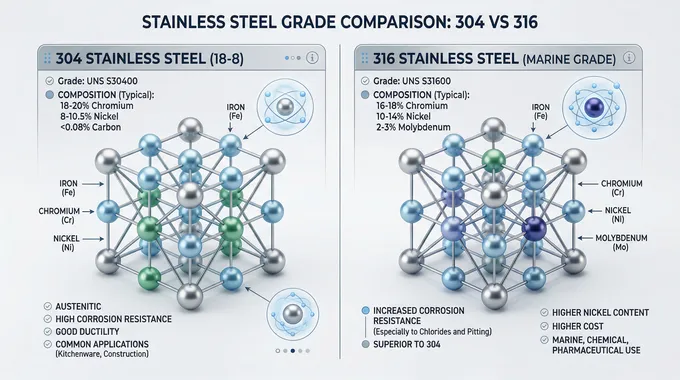
2.1 Austenitic Stainless Steel
Definition and Performance Characteristics: Austenitic stainless steel is stainless steel that has an austenitic structure at room temperature. Its basic composition is based on ferritic stainless steel with a certain amount of nickel added. It has good plasticity and toughness, excellent corrosion resistance, and is non-magnetic. |
Typical Grades and Applications:
304 Stainless Steel: Is the most common austenitic stainless steel grade, containing about 18% chromium and about 8% nickel. Widely used in architectural decoration, food processing equipment, chemical containers.
316 Stainless Steel: Adds 2%-3% molybdenum based on 304. Further improves corrosion resistance, especially against chloride ion corrosion. Often used in marine environments.
304L & 316L: Low-carbon variants used in applications requiring welding to minimize carbide precipitation and reduce intergranular corrosion risk.
2.2 Ferritic Stainless Steel
Definition and Performance Characteristics: Has a ferritic structure at room temperature. Chromium content is generally 11.5%-32%, with low carbon (<0.12%). Good oxidation resistance and excellent stress corrosion resistance, but poor toughness. |
Typical Grade: 430 Stainless Steel (16%-18% chromium). Mainly used for automobile exhaust pipes and home appliance casings.
2.3 Martensitic Stainless Steel
Definition and Performance Characteristics: Obtains martensitic structure through heat treatment. Chromium 12%-18%, carbon 0.1%-0.45%. High strength, high hardness, good wear resistance, but relatively weak corrosion resistance. |
Typical Grades: 410 (cutting tools, bearings) and 420 (surgical blades).
2.4 Duplex & Precipitation Hardening Stainless Steel
Duplex (e.g., 2205): Combines austenitic and ferritic structures. High strength and strong stress corrosion resistance. Used in offshore platforms and chemical reactors.
Precipitation Hardening (e.g., 17-4PH): Achieves high strength via intermetallic compound precipitation during heat treatment. Used in aerospace and nuclear industries.
3. Selection and Application of Stainless Steel Grades

When selecting a stainless steel grade, multiple factors need to be comprehensively considered, including corrosion resistance, strength, toughness, processing performance, cost, and service environment. Matching the specific environmental demands (like exposure to chlorides or extreme temperatures) with the material's structural properties ensures longevity and safety in engineering applications.
4. Future Development Trends
With the continuous development of the manufacturing industry, performance requirements for stainless steel are increasing. Future trends include balancing ultra-high strength with high corrosion resistance, developing special powders for additive manufacturing (3D printing), advancing surface engineering for functionalized coatings, and promoting green manufacturing for sustainable development.