Understanding the Difference Between Nominal Diameter DN, Inner Diameter, and Outer Diameter: Breaking Common MisconceptionsIntroductionIn the design, installation, and maintenance of piping systems, the selection and specification of pipe sizes is a critical step. However, the three key parameters—Nominal Diameter (DN), Inner Diameter (ID), and Outer Diameter (OD)—are often confused, leading to engineering errors. For example, in a chemical project, DN100 was mistakenly interpreted as 100mm inner diameter, resulting in insufficient flow and system shutdown. In a building plumbing project, confusion between DN and De labeling caused incompatible fittings and delayed the project for months. These cases reveal a widespread problem: industry professionals often misunderstand the definitions and relationships between DN, ID, and OD. This article systematically analyzes the differences between these three parameters through standard interpretation, numerical comparison, and engineering cases, providing authoritative reference for professionals. 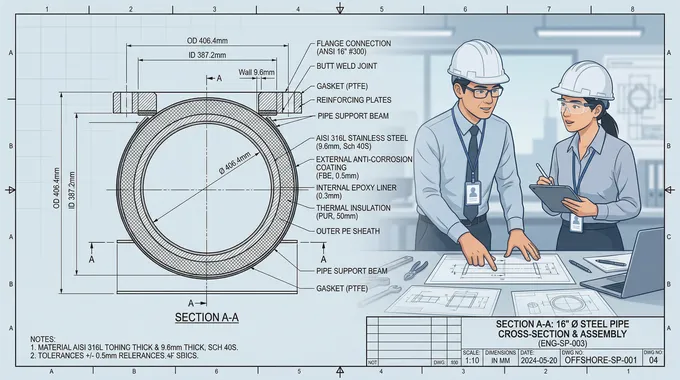 1. Core Concept Definitions and Standard Basis1.1 Standardized Definition of Nominal Diameter (DN)According to the national standard GB/T 1047-2005 Definition and Selection of DN (Nominal Size) for Pipe Components, Nominal Diameter (DN) is a standardized size used to identify pipe components in piping systems, expressed as "DN + number" (e.g., DN15, DN100). It is essentially an artificially specified nominal size that does not directly correspond to the actual inner diameter nor equal the outer diameter, but enables interchangeability of pipe components through standardization. For example, the actual outer diameter of a DN100 seamless steel pipe could be 108mm or 114mm, with inner diameter ranging from 98-104mm depending on wall thickness.Standard Evolution: - The 1995 edition of GB/T 1047 allowed alternative identifiers such as NPS (Nominal Pipe Size); - The 2005 edition explicitly specifies DN as the preferred identifier, fully equivalent to international standard ISO 6708:1995; - GB/T 1047-2025, implemented in 2025, further refines the DN series, adding large diameter specifications such as DN1200 and DN1400. 1.2 Physical Definitions of Inner Diameter (ID) and Outer Diameter (OD)- Inner Diameter (ID): The straight-line distance between the inner walls of the pipe, which directly determines the fluid flow capacity. For example, a DN50 welded steel pipe with outer diameter 57mm and wall thickness 3.5mm has an inner diameter of 50mm.- Outer Diameter (OD): The straight-line distance between the outer walls of the pipe, which is a key parameter for fitting connection and support design. For example, a DN200 spiral steel pipe has a uniform outer diameter of 219mm, but inner diameter varies from 197-207mm depending on wall thickness (6-12mm).Measurement Standards: - Inner diameter measurement requires an internal micrometer with accuracy of ±0.01mm; - Outer diameter measurement uses a vernier caliper or laser diameter measuring instrument with error controlled within ±0.05mm. 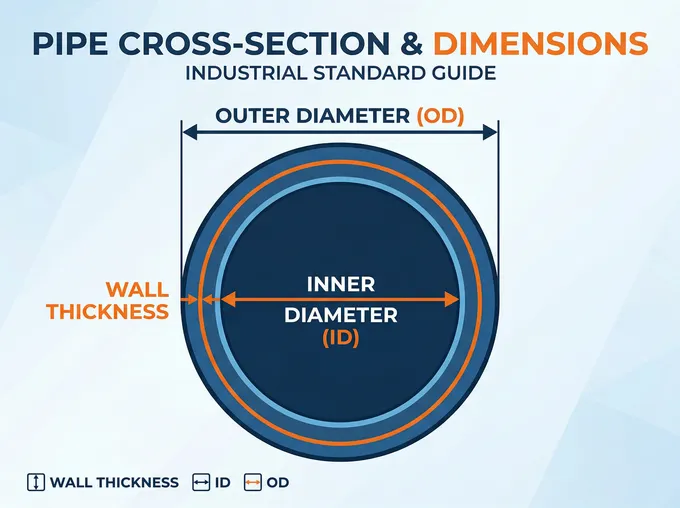 2. Numerical Relationship Analysis Between DN, ID, and OD2.1 Correlation Model Between DN and ODTheoretical Formula: DN ≈ OD − 2 × wall thickness This formula only applies to thin-walled pipes (wall thickness/outer diameter ≤ 0.1), with errors exceeding 10% for thick-walled pipes. For example: - DN150 seamless steel pipe (OD = 168.3mm, wall thickness 8mm): - DN300 spiral steel pipe (OD = 323.9mm, wall thickness 12mm): Engineering Practice: - Galvanized steel pipe: DN20 corresponds to OD = 26.9mm, wall thickness 2.65mm, calculated DN = 21.6mm (rounded to 20mm); - PVC drainage pipe: De110 (OD = 110mm) corresponds to DN100, wall thickness 3.2mm, calculated DN = 103.6mm (rounded to 100mm). 2.2 Dynamic Relationship Between DN and IDWall Thickness Influence: With the same DN value, differences in wall thickness for different pressure ratings or pipe series cause inner diameter fluctuations. For example: - DN50 welded steel pipe: - DN200 seamless steel pipe: Flow Calculation Correction: Actual flow needs to be corrected based on inner diameter, formula: Qactual = Qtheoretical × (IDactual / IDtheoretical)² For example, if the design calculates a flow rate of 100m³/h based on DN100 (ID = 100mm), but the actual inner diameter is 95mm, the actual flow rate is: 3. Differences in Labeling Systems for Different Pipe Materials3.1 Labeling Rules for Metallic PipesPipe TypeLabeling MethodExampleStandard BasisGalvanized Steel PipeDNDN15, DN20GB/T 3091-2015Seamless Steel PipeOD × Wall ThicknessΦ108×4, Φ219×8GB/T 8163-2018Welded Steel PipeOD × Wall ThicknessΦ325×10, Φ426×12GB/T 3092-2020Copper PipeDw (Nominal OD)Dw15.88, Dw22.22GB/T 18033-2017Special Cases: - Thin-walled stainless steel pipes use Dw labeling, e.g., Dw28.58 corresponds to DN25; - Cast iron pipes are labeled with DN, but actual inner diameter is 5-10mm larger than steel pipes of the same DN (e.g., DN100 cast iron pipe ID = 105mm). 3.2 Labeling Rules for Non-Metallic PipesPipe TypeLabeling MethodExampleStandard BasisPVC PipeDe × e (Nominal OD × Wall Thickness)De63×3.0, De110×4.2GB/T 10002.1-2006PP-R PipeDe × eDe25×2.8, De32×3.6GB/T 18742.2-2017PE PipeDe × eDe90×5.4, De200×11.9GB/T 13663.2-2018Concrete Piped (Inner Diameter)d300, d800GB/T 11836-2009Conversion Relationships: - PVC pipe: De110 ≈ DN100 (OD = 110mm, ID = 103.6mm); - PE pipe: De200 ≈ DN180 (OD = 200mm, ID = 176.2mm); - Concrete pipe: d800 ≈ DN700 (ID = 800mm, OD = 880mm). 4. Common Misconceptions and Solutions in Engineering Applications4.1 Misconception 1: DN = ID or DN = ODCase Alert:A heating project selected DN200 spiral steel pipe with a design flow rate of 300m³/h. The construction team mistakenly assumed DN200 means 200mm inner diameter, but due to 12mm wall thickness, the actual inner diameter was only 193.7mm, resulting in insufficient flow (less than 280m³/h) and the system failing to meet requirements.Solutions: - Create a DN-ID-OD comparison table to clarify conversion relationships for different pipe materials; - Use 3D design software (such as AutoCAD Plant 3D) to automatically verify pipe size compatibility. 4.2 Misconception 2: Confusing DN and NPS LabelingCase Alert:A multinational project used both DN (metric) and NPS (imperial) labeling. DN150 (OD = 168.3mm) was mistaken for NPS6 (OD = 168.3mm), but the wall thickness series for NPS6 differs from DN150, resulting in misaligned flange bolt holes.Solutions: - Unify the labeling system, prioritize DN; - Clearly specify the labeling standard in the contract (e.g., "DN150 (NPS6) according to GB/T 1047-2025"). 4.3 Misconception 3: Ignoring the Impact of Pipe ScheduleCase Alert:A chemical pipeline used DN50 SCH80 steel pipe (wall thickness 6.02mm), but the valve was selected according to SCH40 (wall thickness 3.91mm), resulting in flange sealing failure.Solutions: - Develop pipe fitting selection specifications, mandating consistent Schedule for pipes, valves, and flanges; - Use intelligent selection systems (such as SOLIDWORKS Piping) to automatically match pipe schedules.  5. Future Trends: Digital Pipe Size Management5.1 Intelligent Pipe Size Recognition in BIM TechnologyThrough BIM software such as Revit, it is possible to: - Automatically parse DN labels and generate 3D models; - Real-time verify compatibility between pipe size, flow, and pressure; - Output pipe size lists and material takeoff (MTO) statistics. 5.2 IoT Pipe Size MonitoringEmbedding sensors in pipes enables: - Real-time measurement of inner diameter changes (e.g., scaling, corrosion monitoring); - Predict pipe diameter attenuation trends through digital twin technology; - Trigger warning mechanisms (e.g., alarm when inner diameter is reduced by 10%). ConclusionAs the standardized language of piping systems, the difference between nominal diameter DN and inner/outer diameter is a core point in engineering design. This article reveals the following key conclusions through standard interpretation, numerical modeling, and case analysis: 1. DN is a nominal size that does not directly correspond to a physical dimension and needs to be estimated via OD-2×wall thickness; 2. ID is the determining factor for flow and requires dynamic correction based on wall thickness; 3. Labeling systems vary by pipe material—metallic pipes mostly use DN, while non-metallic pipes commonly use De or d; 4. Engineering errors stem from cognitive bias and need to be avoided through standardized processes and digital tools. In the context of piping systems developing towards intelligence and integration, a deep understanding of the relationship between DN, ID, and OD is not only a technical requirement but also an inevitable choice for ensuring engineering safety and improving efficiency.
|


Search for more information